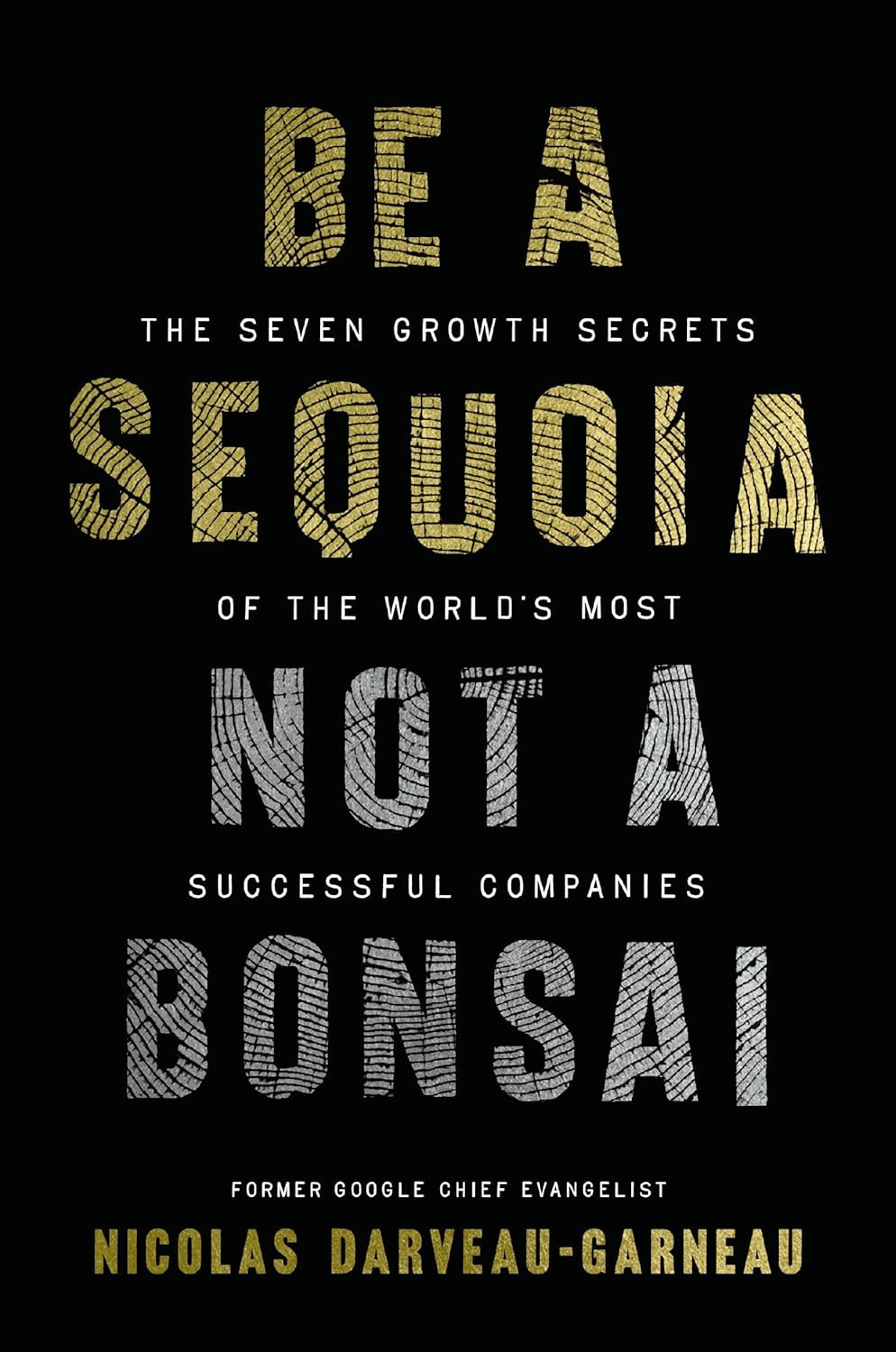
Be a Sequoia, Not a Bonsai by Nicolas Darveau-Garneau

Be a Sequoia, Not a Bonsai

Nicolas Darveau-Garneau

Format: Audio/Print Personal Score: 8.5 / 10

The most important difference between sequoias and bonsai is their goal.

Essence (why this landed for me)

A reset on what growth actually means. Not more activity, not better efficiency charts, but profitable growth that compounds. The sequoia vs bonsai metaphor caught a trap I recognize: optimizing for control instead of creating conditions for growth. It pushed me to rethink how teams get measured, how KPIs drift toward efficiency theater, and how a single executive question can shrink ambition without anyone noticing. Useful because the principles apply at every level: product decisions, team culture, and organizational strategy.

Insights (mapped to mental models)

Takeaways grouped by mental models, with a short action you can use now.

Pick the goal first: profit growth, not efficiency theater.

ACTION Write the goal in one line.
HOW IT SHOWS UP IN THE BOOK Sequoias are genetically programmed to grow tall. Bonsai stay small because they are pruned by humans. The same is true in business.
MENTAL MODELS First Principles, Goals vs Metrics, Map ≠ Territory
MODEL CLUSTER Logic & Reasoning

If the KPI is wrong, the whole system drifts.

ACTION Name one metric to stop chasing.
HOW IT SHOWS UP IN THE BOOK More than 95 percent of marketers focus on efficiency metrics like CAC and ROAS instead of trying to maximize profits. Marketing is often just the canary in the coal mine.
MENTAL MODELS Goodhart's Law, Systems Thinking, Leading Indicators
MODEL CLUSTER Systems & Adaptation

Optimize for profitable growth, not cheapest growth.

ACTION Measure profit impact per experiment.
HOW IT SHOWS UP IN THE BOOK EverQuote increased profits by 170 percent after switching from ROAS to a profit-maximizing KPI. Many retailers more than doubled advertising profits by simply changing the definition of profits.
MENTAL MODELS Opportunity Cost, Second-Order Thinking, Compounding
MODEL CLUSTER Growth & Focus

Don't chase more customers, chase better customers.

ACTION Define your 'most valuable customer'.
HOW IT SHOWS UP IN THE BOOK Surex acquired 60 percent fewer high-risk customers and 90 percent more in the most profitable segment. The shift helped quadruple profits within a year.
MENTAL MODELS Pareto Principle, Segmenting, Incentives
MODEL CLUSTER Growth & Focus

Treat CLV as a design problem, not a finance problem.

ACTION Pick one CLV lever to improve.
HOW IT SHOWS UP IN THE BOOK By growing CLV faster, sequoias earn more per existing customer and can invest more to acquire new ones. This creates a flywheel of sustained, profitable growth.
MENTAL MODELS Systems Thinking, Feedback Loops, Second-Order Thinking
MODEL CLUSTER Systems & Adaptation

Delight is not fluff, it is a growth engine.

ACTION Add one 'delight check' to reviews.
HOW IT SHOWS UP IN THE BOOK Asbury achieved a 30 percent increase in customer satisfaction, 22 percent revenue growth, and 33 percent rise in profits while competitors saw profits drop 10 percent.
MENTAL MODELS Reciprocity, Flywheel, Feedback Loops
MODEL CLUSTER Systems & Adaptation

Build a culture where testing is normal, not heroic.

ACTION Set a weekly experiment cadence.
HOW IT SHOWS UP IN THE BOOK Sequoias stay ahead because they test and scale new ideas faster and more aggressively than bonsai. Chapter 7 covers how to build a world-class system for generating, testing, and implementing growth ideas.
MENTAL MODELS Feedback Loops, Compounding, Standard Operating Procedures
MODEL CLUSTER Systems & Adaptation

Simple, low-risk experiments beat big bets that stall.

ACTION Design 3 small tests this week.
HOW IT SHOWS UP IN THE BOOK These ideas don't rely on risky acquisitions, hit-and-miss new product development, or expensive technology investments. All you need is the willingness to think differently and try new things.
MENTAL MODELS Optionality, Risk Management, Expected Value
MODEL CLUSTER Growth & Focus

In the AI era, metric mistakes scale faster than ever.

ACTION Add a 'metric risk' line to plans.
HOW IT SHOWS UP IN THE BOOK Advanced AI algorithms can quickly accelerate a company off course when given the wrong objectives. Optimizing the wrong KPI has always been problematic, but in the age of AI, it can be catastrophic.
MENTAL MODELS Second-Order Thinking, Unintended Consequences, Leverage
MODEL CLUSTER Human Judgment & Bias

Profitable growth needs alignment, not just marketing effort.

ACTION Align the KPI with finance early.
HOW IT SHOWS UP IN THE BOOK We need to convince the heads of the business unit, the CMO, and the CFO before a company changes its KPIs. It's a big shift in mindset.
MENTAL MODELS Incentives, Principal–Agent, Coordination Costs
MODEL CLUSTER Human Judgment & Bias

Absorption Notes (short essay)

Start by naming the goal in plain language, then pick the few measures that actually represent it. If a metric can be gamed without real progress, it is not a safe guide. Test each KPI with one question: does moving this number guarantee profit grows. If not, redefine it or drop it. The dashboard I build shapes the decisions I make. The next part is rhythm. A weekly habit of small experiments that are cheap, learn fast, and connect back to profit, not vanity. Ship something small, learn from real behavior, tighten the loop, then repeat. When something works, turn it into a repeatable play, not a one-time win. When it does not, the learning still stacks. Stay disciplined and keep the focus on one metric that balances growth and efficiency: profit.

Reflection Prompts (product × design × engineering)

Questions to apply the ideas across projects. Pick one or two and use them today.

Goal first

Am I optimizing for profit growth or just efficiency

First Principles

Name the goal.

Metric sanity

Which KPI could be gamed without real progress

Goodhart's Law

Kill one metric.

Stop list

What should I stop measuring because it misleads me

Inversion

Remove one.

Value customer

Who is my most valuable customer and why

Pareto Principle

Define the segment.

CLV lever

What one lever would raise lifetime value the most

Leverage

Pick one lever.

Delight test

Where can I add delight without adding complexity

Second-Order Thinking

Small change, big feel.

Experiment cadence

What is my weekly experiment rhythm and what blocks it

Feedback Loops

Set the cadence.

Three small tests

What three small tests replace one big risky bet

Optionality

Design 3 tests.

AI metric risk

If AI scales this, what harm does the wrong KPI cause

Unintended Consequences

Write the downside.

Alignment

Who must agree on the KPI for this to stick

Incentives

Align early.

Quotes (anchors; verbatim)