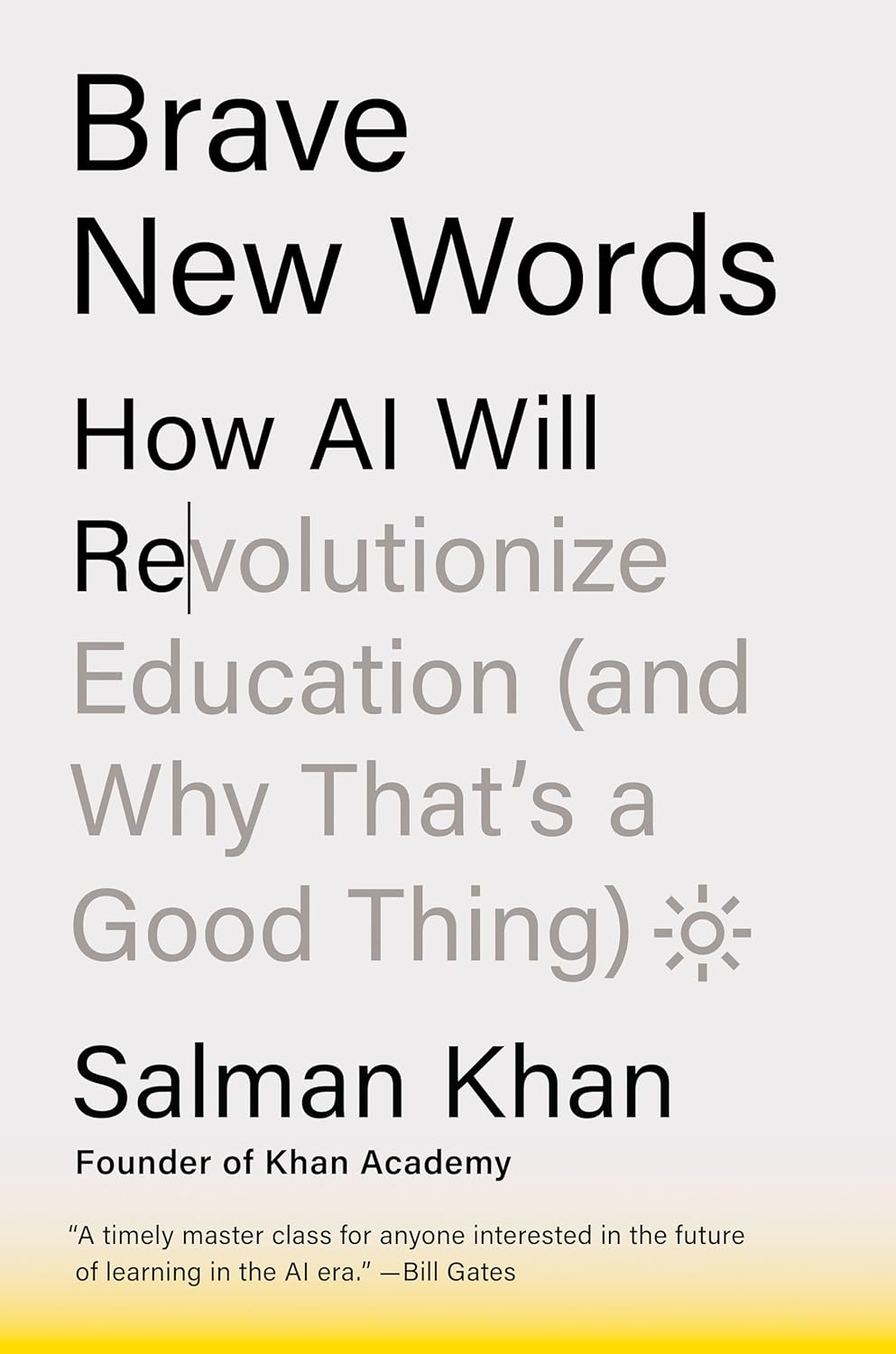
Brave New Words by Salman Khan

Brave New Words

Salman Khan

Format: Audio/Print Personal Score: 7.5 / 10

AI can help every student learn at their own pace with mastery.

Essence (why this landed for me)

As someone in edtech, this felt close to home. The future Khan describes does not read like fantasy; it reads like work to be done. I like the vision, but I prefer the term AI companion over AI tutor, a steady presence across the learning journey. The book also keeps ethics and child safety in frame, which is a needed reminder for how I build.

Insights (mapped to mental models)

Takeaways grouped by mental models, with a short action you can use now.

Design the companion, not a replacement teacher

ACTION Write the companion’s role.
HOW IT SHOWS UP IN THE BOOK AI supports practice, feedback, and pacing while humans lead values and judgment.
MENTAL MODELS Human-Centered Design, Role Clarity
MODEL CLUSTER Logic & Reasoning

Mastery learning beats calendar learning

ACTION Gate on mastery.
HOW IT SHOWS UP IN THE BOOK Progress moves after evidence of understanding, not after fixed time.
MENTAL MODELS Mastery Learning, Feedback Loops
MODEL CLUSTER Systems & Adaptation

Personalization needs a clear learner model

ACTION Sketch the learner state.
HOW IT SHOWS UP IN THE BOOK Keep a living map of skills, gaps, and confidence to choose next tasks.
MENTAL MODELS Bayesian Updating, State Machines
MODEL CLUSTER Logic & Reasoning

Short feedback loops drive motivation

ACTION Tighten the loop.
HOW IT SHOWS UP IN THE BOOK Fast hints, checks, and nudges keep effort and attention up.
MENTAL MODELS Operant Feedback, Goal Gradients
MODEL CLUSTER Growth & Focus

Spaced practice protects memory

ACTION Schedule reviews.
HOW IT SHOWS UP IN THE BOOK Revisit skills with spaced prompts so gains last.
MENTAL MODELS Spaced Repetition, Forgetting Curve
MODEL CLUSTER Systems & Adaptation

Explain the why, not just the what

ACTION Add one rationale.
HOW IT SHOWS UP IN THE BOOK Step-by-step reasoning and worked examples improve transfer.
MENTAL MODELS Worked Examples, Cognitive Load
MODEL CLUSTER Logic & Reasoning

Keep kids safe by design

ACTION Add age gates.
HOW IT SHOWS UP IN THE BOOK Age-appropriate prompts, content filters, and adult controls are core, not add-ons.
MENTAL MODELS Risk Management, Constraints → Creativity
MODEL CLUSTER Systems & Adaptation

Privacy is a requirement, not a feature

ACTION Minimize data.
HOW IT SHOWS UP IN THE BOOK Collect only what the learning task needs; log provenance and consent.
MENTAL MODELS Data Minimization, Chain of Custody
MODEL CLUSTER Human Judgment & Bias

Measure learning, not clicks

ACTION Define an outcome.
HOW IT SHOWS UP IN THE BOOK Evaluate on mastery gains and retention, not time-on-page.
MENTAL MODELS Goodhart’s Guardrail, Causal Inference
MODEL CLUSTER Logic & Reasoning

Teacher augmentation beats automation

ACTION Design the handoff.
HOW IT SHOWS UP IN THE BOOK Give teachers dashboards, summaries, and targeted next steps.
MENTAL MODELS Interface Design, Leverage Points
MODEL CLUSTER Growth & Focus

Guardrails reduce high-cost errors

ACTION Add a refuse mode.
HOW IT SHOWS UP IN THE BOOK The system defers or asks for help when confidence is low or risk is high.
MENTAL MODELS Calibration, Abstention
MODEL CLUSTER Systems & Adaptation

Language matters for trust

ACTION Rename the role.
HOW IT SHOWS UP IN THE BOOK Terms like companion or coach set proper expectations for families.
MENTAL MODELS Framing, Choice Architecture
MODEL CLUSTER Human Judgment & Bias

Equity is a design constraint

ACTION Plan for low-resource.
HOW IT SHOWS UP IN THE BOOK Offline modes, low-spec devices, and multilingual support widen access.
MENTAL MODELS Second-Order Thinking, Robustness
MODEL CLUSTER Systems & Adaptation

Transparent reasoning builds credibility

ACTION Show steps.
HOW IT SHOWS UP IN THE BOOK Expose hints, steps, and sources so learners and adults can audit.
MENTAL MODELS Falsification, Explainability
MODEL CLUSTER Logic & Reasoning

Document what the system should not do

ACTION Write no-go list.
HOW IT SHOWS UP IN THE BOOK Certain sensitive topics and edge cases require deferral to humans.
MENTAL MODELS Barbell Strategy, Circle of Control
MODEL CLUSTER Growth & Focus

Absorption Notes (short essay)

Build the companion as part of a team: learner, teacher, parent. Start with a clear learner model and one outcome to improve. Keep loops tight: hint, try, check, reflect. Gate progress on evidence of mastery. Schedule spaced reviews so gains stick. Give teachers simple dashboards with suggested next steps, not walls of data. Write the no-go zones, age gates, and refuse paths first. Minimize data, record consent, and make reasoning steps visible so trust can grow. Plan for low-resource settings from day one and localize early. Evaluate on learning outcomes, not engagement vanity. Calm, steady design.

Reflection Prompts (product × design × engineering)

Questions to apply the ideas across projects. Pick one or two and use them today.

Role clarity

What will the AI companion do, and what stays human

Role Clarity

Write the split.

Outcome first

What learning outcome will we measure next month

Causal Inference

Pick one.

Learner model

What skills, gaps, and confidence will we track

Bayesian Updating

Sketch fields.

Mastery gate

What proof will unlock the next step

Mastery Learning

Define evidence.

Spaced plan

How will we schedule reviews so memory holds

Spaced Repetition

Add intervals.

Teacher handoff

What summary would save a teacher five minutes

Interface Design

Draft one.

Safety first

Where should the system abstain or escalate

Risk Management

List cases.

Privacy

What can we stop collecting without hurting learning

Data Minimization

Delete one field.

Equity

Does this work offline or on low-spec devices

Robustness

Plan a mode.

Trust

What steps or sources will we expose to users

Explainability

Show the path.