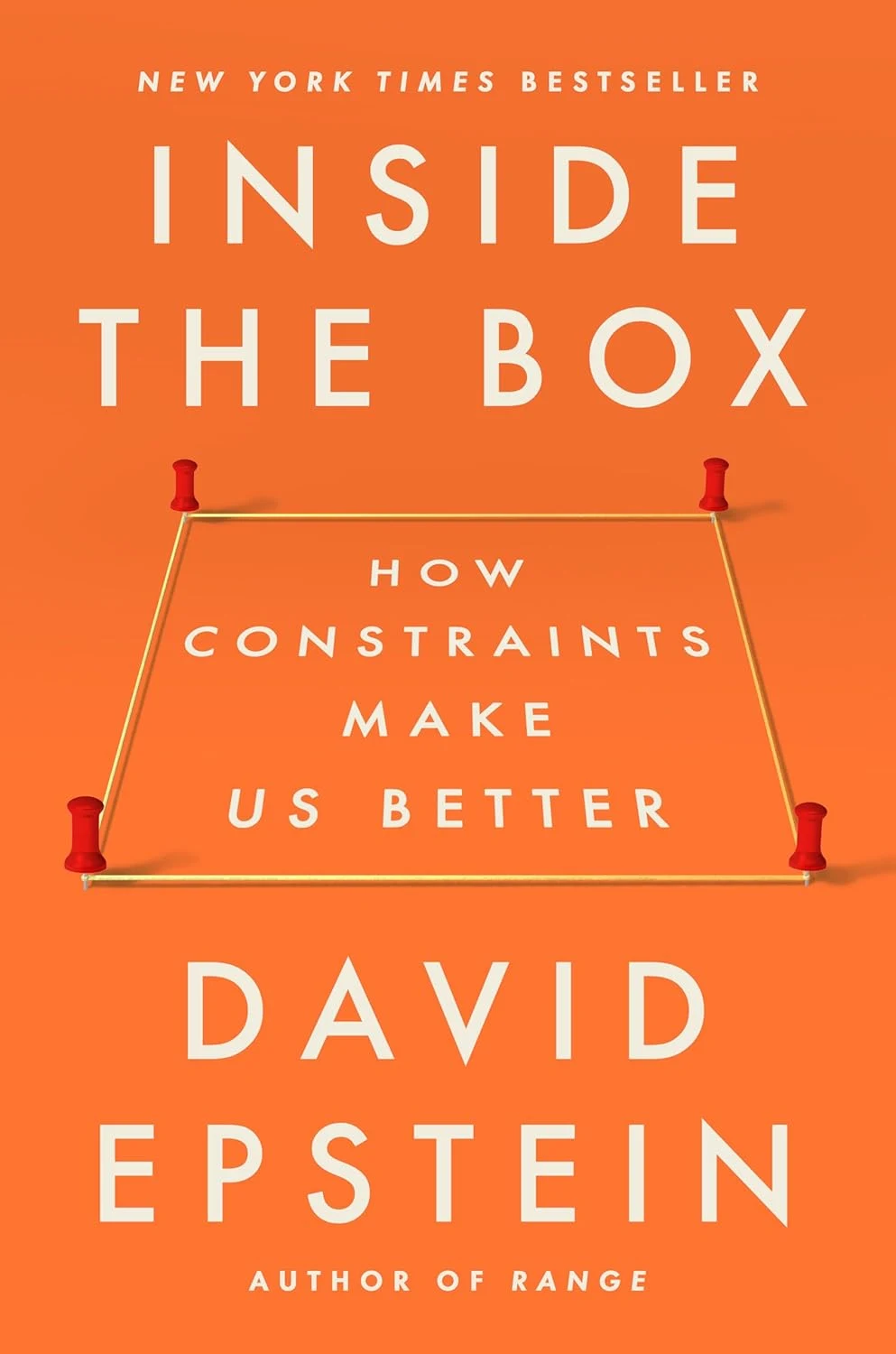
Inside the Box: How Constraints Make Us Better
Choose the box on purpose, then let it do the work.
Essence (why this landed for me)
A book that sent me straight to another one. The pages on Goldratt's Theory of Constraints, the idea that a single bottleneck sets the pace for the whole system, were enough to make me pick up The Goal next. What landed hardest is the case that invention moves as a progression: each breakthrough builds on the person's earlier work or someone else's, reshaped under pressure. Mendeleev was the surprise. The periodic table came out of a textbook deadline and a page budget, and I had never known that. It reframed how I scope teams and products: the limit is often the brief. It is also a reminder that sometimes less can be more.
Insights (mapped to mental models)
Takeaways grouped by mental models, with a short action you can use now.
Constraints block the default path so thinking starts
Every breakthrough is a step in a longer progression
One bottleneck sets the pace of the whole system
More startups die of indigestion than starvation
Stop starting, start finishing
Humans add by default and neglect subtraction
Start with the box, then fill it
Three pitches beat one great idea
Make the trade-off visible or the team polishes pennies
Satisfice on the small stuff to spend judgment where it matters
Write the prediction before the result arrives
Paired constraints: block one move, put another in its place
A broken instrument can be the best brief
Batch the toggles or pay the residue tax
Brain first, tool second
Absorption Notes (short essay)
The practice I want is to name the box before the work starts. For any new initiative, write the brief on one page: the outcome, the budget of time and people, and the one thing we will not do. Then find the drum. Ask which single step sets the pace for the whole system and widen it before optimizing anything else. Keep the bottleneck question close in every planning review. Run the wall exercise once a quarter: every commitment on a sticky note, and nothing new enters until something finishes. Before a decision, write the prediction and the date so I cannot rewrite the story later. When a plan feels stuck, ban the first answer and bring three. Satisfice on the small choices so judgment is saved for the few that matter. Simple moves, steady rhythm.
Reflection Prompts (product × design × engineering)
Questions to apply the ideas across projects. Pick one or two and use them today.
The box
What is the one-page brief for this project: outcome, budget, and the thing we will not do
Constraints → CreativityWrite the brief.
Drum
Which single step sets the pace of this whole system
BottlenecksWiden it first.
Progression
What earlier work, mine or someone else's, does this idea build on
CompoundingTrace the chain.
Wall
How many commitments are live right now versus how many we can actually finish
WIP LimitsPost them all.
Subtract
If I had to cut one thing in the next 90 days, which would it be
InversionCut one.
Three pitches
What are two other ways to solve this beyond my first answer
OptionalityBring three.
Pre-register
What do I predict will happen, and did I write it down before seeing the result
FalsificationDate the bet.
Satisfice
Which decisions deserve good enough so the big ones get my full attention
SatisficingSet the rule.
Broken piano
What limitation am I fighting that could become the brief
AntifragilityPlay what I have.
Brain first
Where am I handing the thinking to a tool before doing it myself
Desirable DifficultyThink, then prompt.