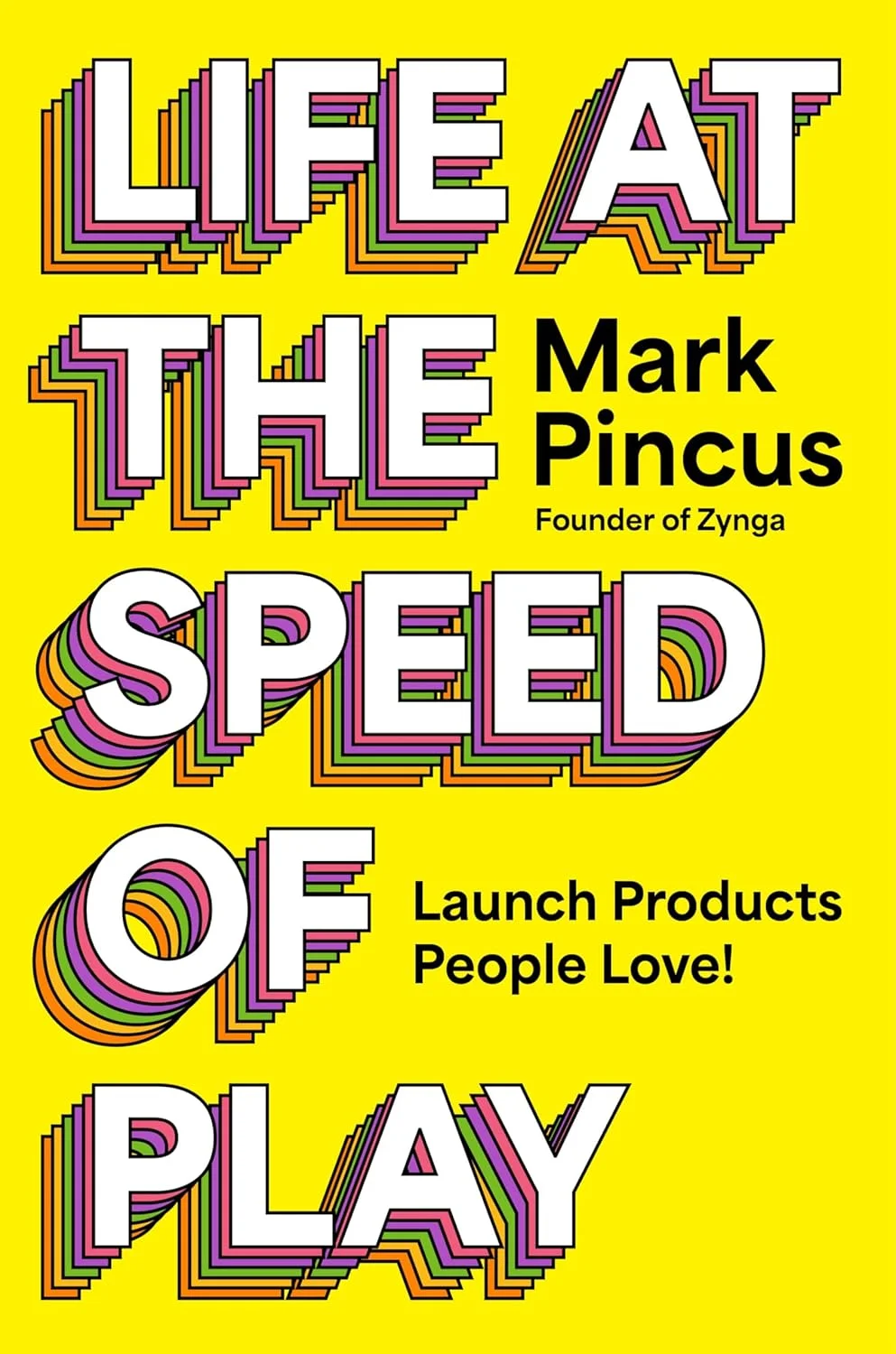
Life at the Speed of Play: Launch Products People Love! by Mark Pincus

Life at the Speed of Play: Launch Products People Love!

Mark Pincus

Format: Audio/Print Personal Score: 8.4 / 10

Your instinct is probably right, but your idea is probably wrong.

Essence (why this landed for me)

I picked this up out of pure curiosity. For years I passed the Zynga building on the freeway and wondered whether the company still existed, and I had never heard of its founder. What I found reads like an operating manual: split the instinct from the idea, isolate the one truly new thing, and test it before anyone falls in love with it. The line that stayed is that real speed is measured in how fast you learn. That reframes how I want to run product bets now that testing is nearly free.

Insights (mapped to mental models)

Takeaways grouped by mental models, with a short action you can use now.

Trust the instinct, distrust the idea

ACTION Write my instinct, then my idea.
HOW IT SHOWS UP IN THE BOOK Pincus puts instinct right about 95 percent of the time and the idea wrong at least 75 percent. smstaxi.com was the right instinct, years before Uber, wrapped in the wrong idea.
MENTAL MODELS Map ≠ Territory, Falsification★
MODEL CLUSTER Logic & Reasoning

All new fails, so make the new part small and cheap

ACTION Shrink the new part.
HOW IT SHOWS UP IN THE BOOK He expects every new idea to fail on first contact, so the novel piece gets many cheap variants in small units instead of one big bet.
MENTAL MODELS Base Rates, Optionality★
MODEL CLUSTER Growth & Focus

Proven, Better, New isolates the one real bet

ACTION Tag every feature P, B, or N.
HOW IT SHOWS UP IN THE BOOK Copy what already works for the audience, improve one axis users would notice, and reserve a single genuinely new idea. Social versions of Civilization and SimCity failed because they innovated on onboarding instead of copying the proven one.
MENTAL MODELS First Principles★, Signal vs Noise
MODEL CLUSTER Logic & Reasoning

Bold Beats are one-day tests that move the whole game

ACTION Ship one bold beat.
HOW IT SHOWS UP IN THE BOOK Making the animals move in FarmVille took a day and players went wild. A bold beat is fast, isolated, and readable in the metrics, so it is quick to test and quick to kill.
MENTAL MODELS Leverage, Feedback Loops★
MODEL CLUSTER Systems & Adaptation

Test more ideas in a week than the industry does in a year

ACTION Count my tests per week.
HOW IT SHOWS UP IN THE BOOK That was the Zynga mantra. Run a deliberate failure machine, because only speed finds the 25 percent of ideas that work before they get expensive.
MENTAL MODELS Tempo, Compounding★
MODEL CLUSTER Systems & Adaptation

Launch when the winnings are already on the table

ACTION Find true signal first.
HOW IT SHOWS UP IN THE BOOK He replaces the MVP with a Minimum Idea State to test and a Maximum Launch Product to ship: find true signal with real users, then overinvest with conviction.
MENTAL MODELS Leading Indicators, Margin of Safety
MODEL CLUSTER Growth & Focus

True signal feels like the fish running

ACTION Name my true-signal test.
HOW IT SHOWS UP IN THE BOOK True signal is when every feedback loop is a clear yes and the team works harder without being asked. His image is the night you are up throwing nets because the catch is right there.
MENTAL MODELS Threshold Effects, Pattern Recognition★
MODEL CLUSTER Human Judgment & Bias

A B+ is the enemy of an A

ACTION Kill my B+ this week.
HOW IT SHOWS UP IN THE BOOK Mediocre projects survive because they are never bad enough to kill. FarmVille 3 absorbed 70 to 80 million dollars without reaching a product because nobody would call it.
MENTAL MODELS Sunk Cost Fallacy★, Opportunity Cost
MODEL CLUSTER Human Judgment & Bias

Kill hope before hope kills you

ACTION Ask what data supports this.
HOW IT SHOWS UP IN THE BOOK His definition of hope is a belief not supported by any data. The most painful cases were games stuck in development limbo because their creators would not admit it.
MENTAL MODELS Falsification, Confirmation Bias
MODEL CLUSTER Human Judgment & Bias

Forget scale until the product is right

ACTION Protect quality before growth.
HOW IT SHOWS UP IN THE BOOK In 2007 he pulled people off several flat games and put everything behind Poker at 400,000 daily users. On his return as CEO he cut half the studios and halved revenue to refocus on the core.
MENTAL MODELS Focus★, Pareto Principle
MODEL CLUSTER Growth & Focus

Know the goal or suffer death by a thousand compromises

ACTION Write the goal on one line.
HOW IT SHOWS UP IN THE BOOK Without a named goal, endless small decisions drift. His fix is to stop time: commit to a vision with specific outcomes and let it settle the small calls.
MENTAL MODELS Commitment Devices, Backcasting
MODEL CLUSTER Growth & Focus

Management is the right thing happening when I am not in the room

ACTION Check what happens without me.
HOW IT SHOWS UP IN THE BOOK Mission, values, stories, and compensation are all tools for one job: getting people to do the right thing when he is not there. Mission is fixed at 100,000 feet, tactics change at 5,000.
MENTAL MODELS Principles, Principal-Agent Problem
MODEL CLUSTER Systems & Adaptation

Hire people with broken resumes

ACTION Read past the gap.
HOW IT SHOWS UP IN THE BOOK He looks for the drive that forms in a detour or a failure. The Abyss, his name for a stretch without a job or a plan, is where his own deepest instincts formed.
MENTAL MODELS Selection Effects, Antifragility★
MODEL CLUSTER Human Judgment & Bias

Founder mode means making the conviction calls myself

ACTION Make the call myself.
HOW IT SHOWS UP IN THE BOOK Hiring a console executive to run a social gaming company nearly sank Zynga. His lesson: there is no one else to figure it out, so never turn away from your own judgment.
MENTAL MODELS Skin in the Game★, Authority Bias
MODEL CLUSTER Human Judgment & Bias

Partner with my future self once a year

ACTION Write the Book of Life.
HOW IT SHOWS UP IN THE BOOK For thirty years, in the ten days between Rosh Hashanah and Yom Kippur, he asks what Future Mark would thank Present Mark for doing, and writes it down.
MENTAL MODELS Inversion, Long-Term Orientation
MODEL CLUSTER Growth & Focus

Design for free AI, ship what is cheap today

ACTION Design for free compute.
HOW IT SHOWS UP IN THE BOOK Assume AI compute becomes abundant, design the product for that world, then ship the cheapest viable version now. He treats AI as leverage for Proven Better New, while creativity, empathy, and taste stay human.
MENTAL MODELS Inflection Points★, Second-Order Thinking
MODEL CLUSTER Systems & Adaptation

Absorption Notes (short essay)

Start with the split. For any new bet, write the instinct on one line and the idea on another, then treat the idea as the thing to test. Run Proven, Better, New on the roadmap: tag every item, copy the proven parts without ego, pick one better axis, and shrink the new part until it fits a one-week test. Keep a bold beat in flight at all times: one small change, isolated, with a metric I can read in days. Make tests per week the number that matters. Before a launch review, ask whether we are collecting winnings or placing bets, and whether any feedback loop is still a maybe. Hold a monthly B+ review and kill one thing that is merely fine. Once a year, write what my future self would thank me for. Simple moves, steady rhythm.

Reflection Prompts (product × design × engineering)

Questions to apply the ideas across projects. Pick one or two and use them today.

Split

What is my instinct here and what is the idea I have wrapped around it

Falsification

Write both lines.

Proven

Which parts of this product should I copy outright instead of reinventing

First Principles

Copy without ego.

One new thing

What is the single genuinely new idea and how cheaply can I test it

Optionality

Shrink the bet.

Bold beat

What one-day change could open a new dimension for users

Leverage

Ship one.

Tempo

How many real tests did we run this week

Compounding

Count them.

True signal

Is every feedback loop a clear yes or am I reading a maybe as a yes

Pattern Recognition

Wait for the run.

B+ review

Which project is merely fine and surviving because no one will call it

Sunk Cost Fallacy

Kill one.

Hope check

What data actually supports this belief

Confirmation Bias

Find the number.

Not in the room

What do my teams do when I am not there and does the system make the right thing easy

Principal-Agent Problem

Fix the tool.

Future self

What would my future self thank me for starting this year

Inversion

Write it down.

Quotes (anchors; verbatim)