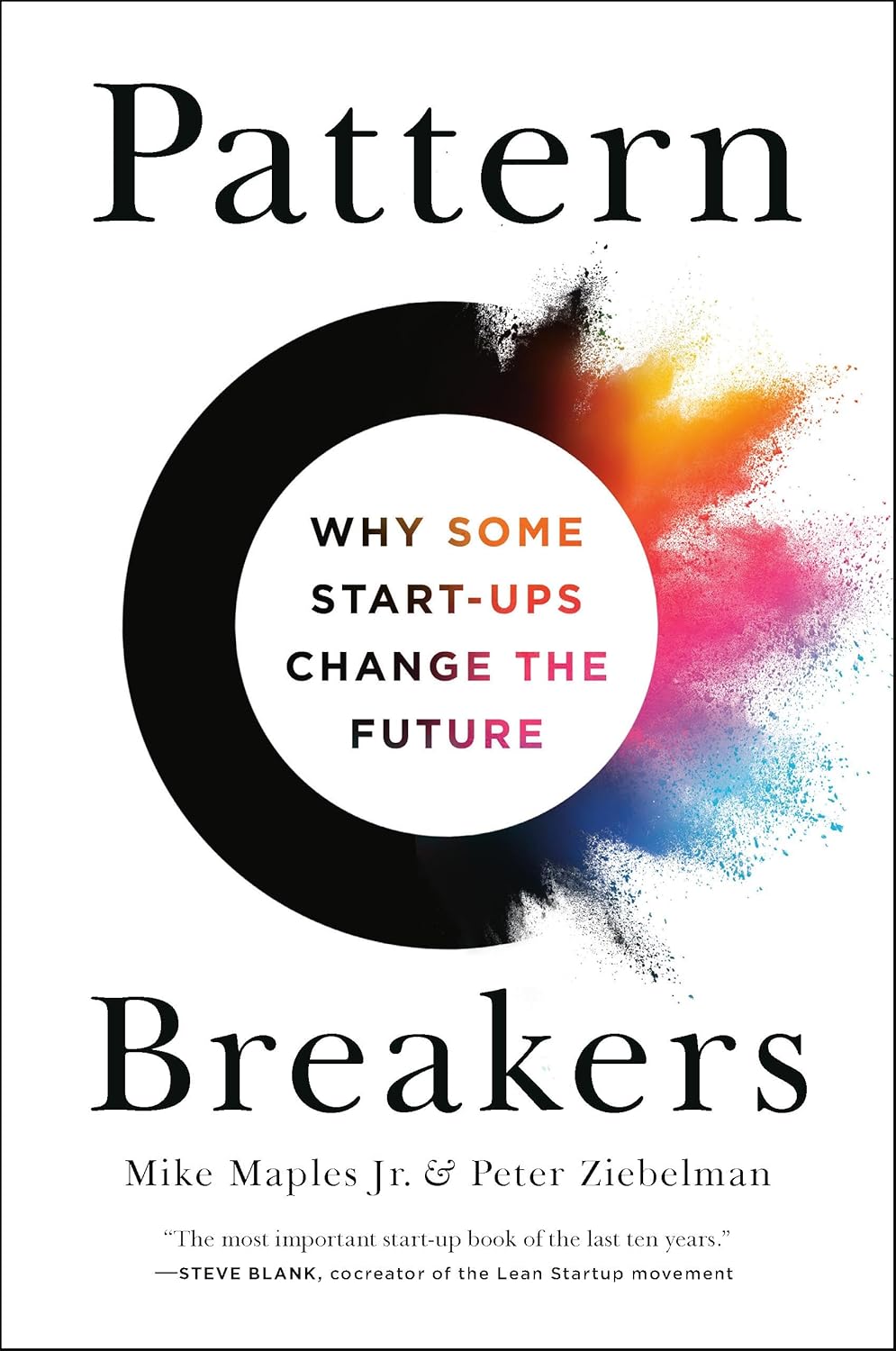
Pattern Breakers by Mike Maples Jr. & Peter Ziebelman

Pattern Breakers

Mike Maples Jr. & Peter Ziebelman

Format: Audio/Print Personal Score: 8.4 / 10

Look for moments when the rules change, then build for the new game.

Essence (why this landed for me)

A handbook for spotting and acting on inflection points. It teaches me to look where the rules are changing, form a clear belief about the future, and backcast to steps I can take now. I like the mix of story, simple tools, and practice. It feels useful for product, design, and engineering because it links narrative to experiments and milestones.

Insights (mapped to mental models)

Takeaways grouped by mental models, with a short action you can use now.

Inflections create new games, not just new features

ACTION Name the rule change.
HOW IT SHOWS UP IN THE BOOK He frames breakthrough companies as those that ride a sharp change in cost, capability, or culture.
MENTAL MODELS Inflection Points, Second-Order Thinking
MODEL CLUSTER Systems & Adaptation

Start with a belief about the future

ACTION Write the future state.
HOW IT SHOWS UP IN THE BOOK He asks founders to declare a non-consensus belief that will become obvious later if true.
MENTAL MODELS Contrarian Truth, Bayesian Updating
MODEL CLUSTER Logic & Reasoning

Backcast from the future to today

ACTION List the stepping stones.
HOW IT SHOWS UP IN THE BOOK Define the endpoint first, then work backward to near-term proofs.
MENTAL MODELS Inversion, Planning from the End
MODEL CLUSTER Logic & Reasoning

Edge use cases reveal tomorrow’s mainstream

ACTION Study the weird users.
HOW IT SHOWS UP IN THE BOOK He spotlights early adopters at the fringe as signals of the coming market.
MENTAL MODELS Lead Users, Power Laws
MODEL CLUSTER Growth & Focus

Secrets live in deltas, not averages

ACTION Hunt for outliers.
HOW IT SHOWS UP IN THE BOOK He looks for surprising pockets of traction that averages hide.
MENTAL MODELS Outliers, Signal vs Noise
MODEL CLUSTER Human Judgment & Bias

Narrative aligns people and capital

ACTION Write the one-line belief.
HOW IT SHOWS UP IN THE BOOK He compresses the thesis into a short, portable story that others can repeat.
MENTAL MODELS Compression, Story Structure
MODEL CLUSTER Growth & Focus

Minimum viable test beats big reveal

ACTION Run a cheap proof.
HOW IT SHOWS UP IN THE BOOK He favors small experiments that prove a step on the backcast path.
MENTAL MODELS Optionality, Feedback Loops
MODEL CLUSTER Systems & Adaptation

Milestones > timelines

ACTION Define threshold tests.
HOW IT SHOWS UP IN THE BOOK Progress is measured by passing irreversible gates, not calendar dates.
MENTAL MODELS Leading Indicators, Threshold Effects
MODEL CLUSTER Systems & Adaptation

Category language is part of product design

ACTION Name the slot.
HOW IT SHOWS UP IN THE BOOK He stresses creating language that helps customers and partners place the new thing.
MENTAL MODELS Positioning, Schemas
MODEL CLUSTER Growth & Focus

Distribution is a design constraint

ACTION Plan the channel first.
HOW IT SHOWS UP IN THE BOOK He treats go-to-market as integral to the core idea, not an afterthought.
MENTAL MODELS Second-Order Thinking, Interface Design
MODEL CLUSTER Systems & Adaptation

Power laws demand focus on few bets

ACTION Prune to the top path.
HOW IT SHOWS UP IN THE BOOK He concentrates time and capital on the small set of moves that can drive outsized outcomes.
MENTAL MODELS Power Laws, Opportunity Cost
MODEL CLUSTER Growth & Focus

Teams need belief and evidence in balance

ACTION Pair story with stats.
HOW IT SHOWS UP IN THE BOOK He combines a clear thesis with concrete signals that momentum is real.
MENTAL MODELS Bayesian Updating, Decision Hygiene
MODEL CLUSTER Human Judgment & Bias

Find the unfair advantage in the stack

ACTION Choose one edge.
HOW IT SHOWS UP IN THE BOOK He looks for proprietary insights, access, or loops that compound.
MENTAL MODELS Moats, Leverage
MODEL CLUSTER Growth & Focus

Design for compounding loops early

ACTION Sketch the flywheel.
HOW IT SHOWS UP IN THE BOOK He highlights systems where usage improves the product or lowers cost.
MENTAL MODELS Network Effects, Learning Curves
MODEL CLUSTER Systems & Adaptation

Beware false positives from easy metrics

ACTION Pick a hard signal.
HOW IT SHOWS UP IN THE BOOK He warns against vanity graphs and favors behavior that predicts retention or revenue.
MENTAL MODELS Goodhart’s Law, Base Rates
MODEL CLUSTER Logic & Reasoning

Founder-market fit shows up as earned insight

ACTION Write the earned secret.
HOW IT SHOWS UP IN THE BOOK He looks for personal history that explains a sharper view of the problem.
MENTAL MODELS Specific Knowledge, Skin in the Game
MODEL CLUSTER Human Judgment & Bias

Absorption Notes (short essay)

Scan for inflections first. Write a short belief about the future that could be right and not yet obvious. Backcast from that belief to three near-term proofs. Define milestone tests that change the plan if they fail. Prefer a minimum viable test over a big reveal. Track one hard signal that predicts real pull, not easy vanity numbers. Spend time with edge users and odd use cases. Name the category slot so others can repeat it. Design distribution with the product so the path to customers is part of the build. Prune projects to the few with power-law potential. Pair story and stats in weekly reviews. Keep the loop tight and compound small proofs.

Reflection Prompts (product × design × engineering)

Questions to apply the ideas across projects. Pick one or two and use them today.

Inflection scan

What rule change is creating a new game here

Inflection Points

Name the shift.

Belief line

What non-consensus belief am I willing to test

Contrarian Truth

Write one line.

Backcast steps

What three stones connect today to the future state

Inversion

List them.

Edge users

Who are the weird early users and what are they doing

Lead Users

Interview two.

Hard signal

Which metric best predicts durable pull

Leading Indicators

Pick one.

MVT

What is the cheapest test that could change my plan

Optionality

Run it.

Milestone gate

What threshold will force a pivot or push

Threshold Effects

Set the bar.

Category slot

What simple phrase helps others place this product

Positioning

Write it.

Distribution first

Which channel constraint should shape today’s design

Second-Order Thinking

Decide now.

Unfair edge

What advantage can compound if I double down

Leverage

Choose one.