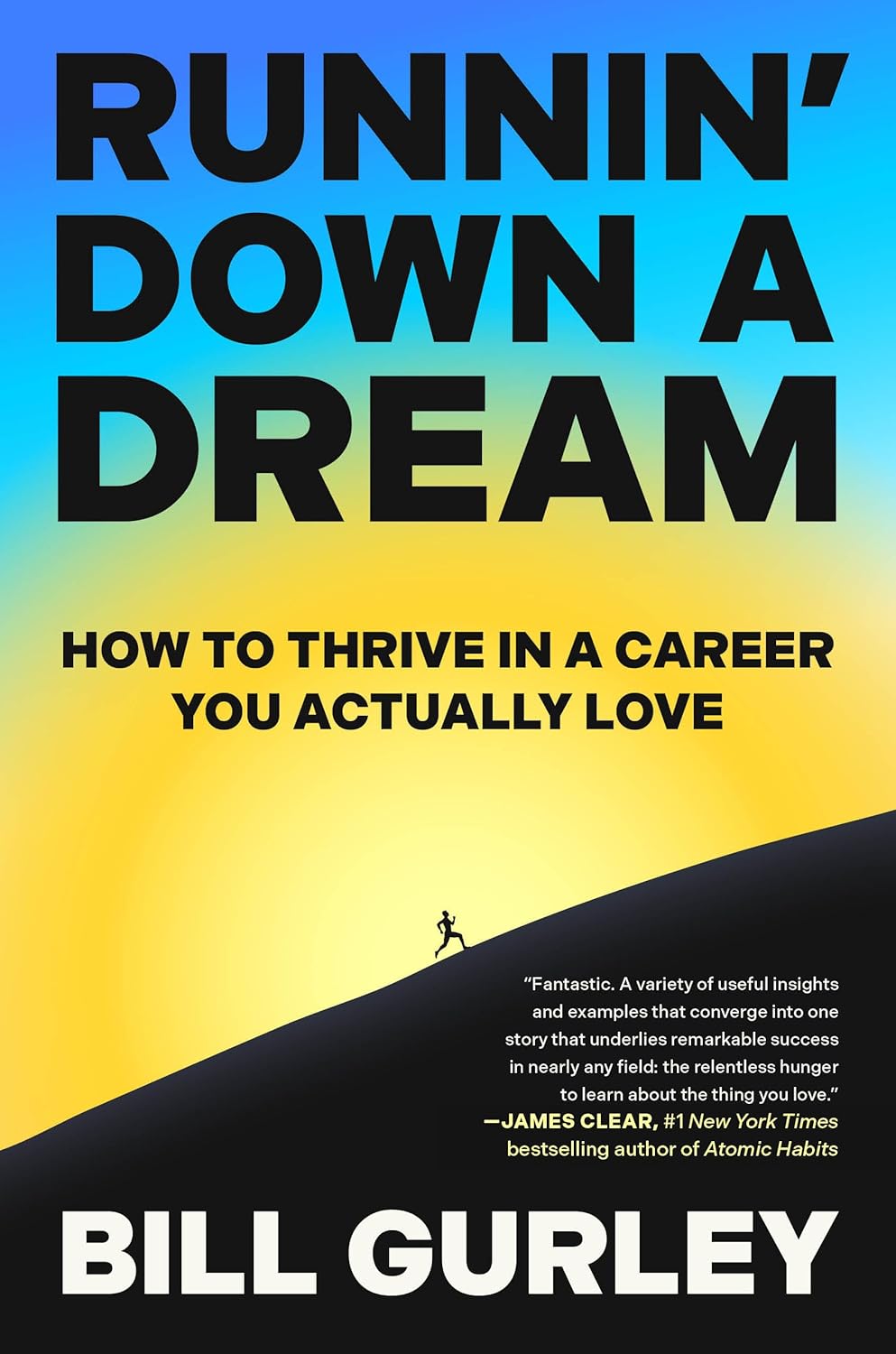
Runnin' Down a Dream by Bill Gurley

Runnin' Down a Dream

Bill Gurley

Format: Print/Audio Personal Score: 8.3 / 10

The real career risk is staying on the conveyor belt.

Essence (why this landed for me)

The voice I needed to hear. Gurley profiles people who followed curiosity, from Danny Meyer to MrBeast, and wraps each story with a usable principle. The thread is simple: the safe path is the riskiest one. The curated book lists for each topic are worth keeping close on their own.

Insights (mapped to mental models)

Takeaways grouped by mental models, with a short action you can use now.

Curiosity is a competitive strategy, not a personality trait.

ACTION Follow what I'd read for free.
HOW IT SHOWS UP IN THE BOOK Gurley uses the Netflix test: if you'd voluntarily read about a field instead of watching TV, that's real curiosity.
MENTAL MODELS Curiosity Loop★, Intrinsic Motivation
MODEL CLUSTER Growth & Focus

The safe path is the one most likely to produce regret.

ACTION Name my boldness regret.
HOW IT SHOWS UP IN THE BOOK Drawing on Daniel Pink's research, he shows that inaction regrets, things not attempted, weigh heaviest over a lifetime.
MENTAL MODELS Inversion, Loss Aversion, Regret Minimization
MODEL CLUSTER Human Judgment & Bias

The conveyor belt moves you forward without asking where.

ACTION Write where I actually want to go.
HOW IT SHOWS UP IN THE BOOK He describes the education system as a conveyor belt: next test, next application, next college, never stopping to ask what you want.
MENTAL MODELS Path Dependence, Default Bias
MODEL CLUSTER Human Judgment & Bias

Master the craft before you try to break the rules.

ACTION Practice one fundamental daily.
HOW IT SHOWS UP IN THE BOOK He opens the craft chapter at the Picasso Museum: Picasso was a technically flawless craftsman before he became revolutionary.
MENTAL MODELS Deliberate Practice★, First Principles
MODEL CLUSTER Growth & Focus

Two tiers of mentorship work better than one cold call.

ACTION Study one aspirational mentor this week.
HOW IT SHOWS UP IN THE BOOK Gurley splits mentors into aspirational (study from afar) and pragmatic (ask directly). About 40% respond to specific, thoughtful questions.
MENTAL MODELS Leverage, Network Effects
MODEL CLUSTER Growth & Focus

Peers who share data and give blunt feedback compound growth.

ACTION Share one real number with my group.
HOW IT SHOWS UP IN THE BOOK MrBeast and three friends spent 16-hour daily Skype sessions for four years sharing YouTube insights. All four became millionaires.
MENTAL MODELS Compounding★, Comparative Advantage
MODEL CLUSTER Growth & Focus

Go where the density of relevant talent is highest.

ACTION Find my epicenter.
HOW IT SHOWS UP IN THE BOOK Tony Fadell read Byte Magazine, noticed every company address was in Northern California, and moved to Silicon Valley after college.
MENTAL MODELS Environment Design★, Network Effects, Opportunity Cost
MODEL CLUSTER Systems & Adaptation

Sense of future boredom is a signal, not a flaw.

ACTION Check if I see myself here in five years.
HOW IT SHOWS UP IN THE BOOK Gurley left Compaq despite it being a dream job because he recognized the product cycles would repeat and boredom would grow.
MENTAL MODELS Second-Order Thinking, Inversion
MODEL CLUSTER Human Judgment & Bias

Giving back is not charity. It cements learning.

ACTION Write one thing I learned this month.
HOW IT SHOWS UP IN THE BOOK He cites Buffett's annual shareholder letters as strategic wisdom-sharing that compounds the writer's own understanding.
MENTAL MODELS Feynman Technique, Reputation Effects
MODEL CLUSTER Growth & Focus

Stories give permission to start unconventional paths.

ACTION Read one biography this quarter.
HOW IT SHOWS UP IN THE BOOK Seinfeld credits The Last Laugh for giving him permission to pursue comedy. Hinkie credits Moneyball for permission to pursue sports analytics.
MENTAL MODELS Social Proof, Narrative Framing
MODEL CLUSTER Human Judgment & Bias

AI amplifies the curious, not the cautious.

ACTION Use AI on one curiosity project today.
HOW IT SHOWS UP IN THE BOOK Gurley argues AI is a super weapon for those on intentional career paths. Deep field knowledge combined with AI fluency creates rare candidacy.
MENTAL MODELS Leverage, Compounding
MODEL CLUSTER Systems & Adaptation

It is never too late to follow a different signal.

ACTION Name one thing I'd start if I could.
HOW IT SHOWS UP IN THE BOOK Tito Beverage made vodka after careers as a seismologist and mortgage broker. Danny Meyer took a 90% pay cut to work in restaurants.
MENTAL MODELS Optionality, Sunk Cost Fallacy
MODEL CLUSTER Human Judgment & Bias

Doing 10% more than expected creates dramatic separation.

ACTION Add one extra to my next deliverable.
HOW IT SHOWS UP IN THE BOOK Gurley observes that most people do the minimum expected. Exceeding by a small margin creates visible differentiation over time.
MENTAL MODELS Marginal Gains, Compounding
MODEL CLUSTER Growth & Focus

Profiles followed by principles make lessons stick.

ACTION Document my next lesson as story then takeaway.
HOW IT SHOWS UP IN THE BOOK Each chapter opens with a profile of someone who lived the principle, making the lesson concrete before stating it abstractly.
MENTAL MODELS Narrative Framing, Learning by Doing
MODEL CLUSTER Logic & Reasoning

Absorption Notes (short essay)

The practice I want is to run the Netflix test regularly: pick a topic and ask whether I'd voluntarily read about it for hours. If yes, go deeper. If not, notice what that says. Keep a two-tiered mentor list. Aspirational tier: one person to study from afar each month through their writing, talks, or work. Pragmatic tier: one direct question to someone accessible each quarter. Write the question before sending it. Build a peer group that shares real data and gives blunt feedback. One number shared, one honest reaction received, each week. Return to the book lists when I need a new thread to pull. Simple moves, steady rhythm.

Reflection Prompts (product × design × engineering)

Questions to apply the ideas across projects. Pick one or two and use them today.

Curiosity test

What would I read about voluntarily instead of watching TV

Intrinsic Motivation

Name the topic.

Conveyor belt

Where am I moving forward without asking where I want to go

Path Dependence

Stop and ask.

Boldness regret

What will I regret not trying ten years from now

Regret Minimization

Name it now.

Craft

What fundamental have I stopped practicing

Deliberate Practice

Pick one drill.

Mentor tier

Who am I studying from afar that I could ask one direct question

Leverage

Send one message.

Peer group

Who in my circle pushes me with data and blunt feedback

Network Effects

Share one number.

Epicenter

Am I close enough to the density of talent that matters to my work

Environment Design

Move toward it.

Future boredom

If I project five years here, what does the daily work look like

Second-Order Thinking

Be honest.

Give back

What have I learned that someone earlier on the path could use

Feynman Technique

Write it down.

Permission

Whose story gives me permission to start the thing I keep postponing

Social Proof

Find the story.

Quotes (anchors; verbatim)