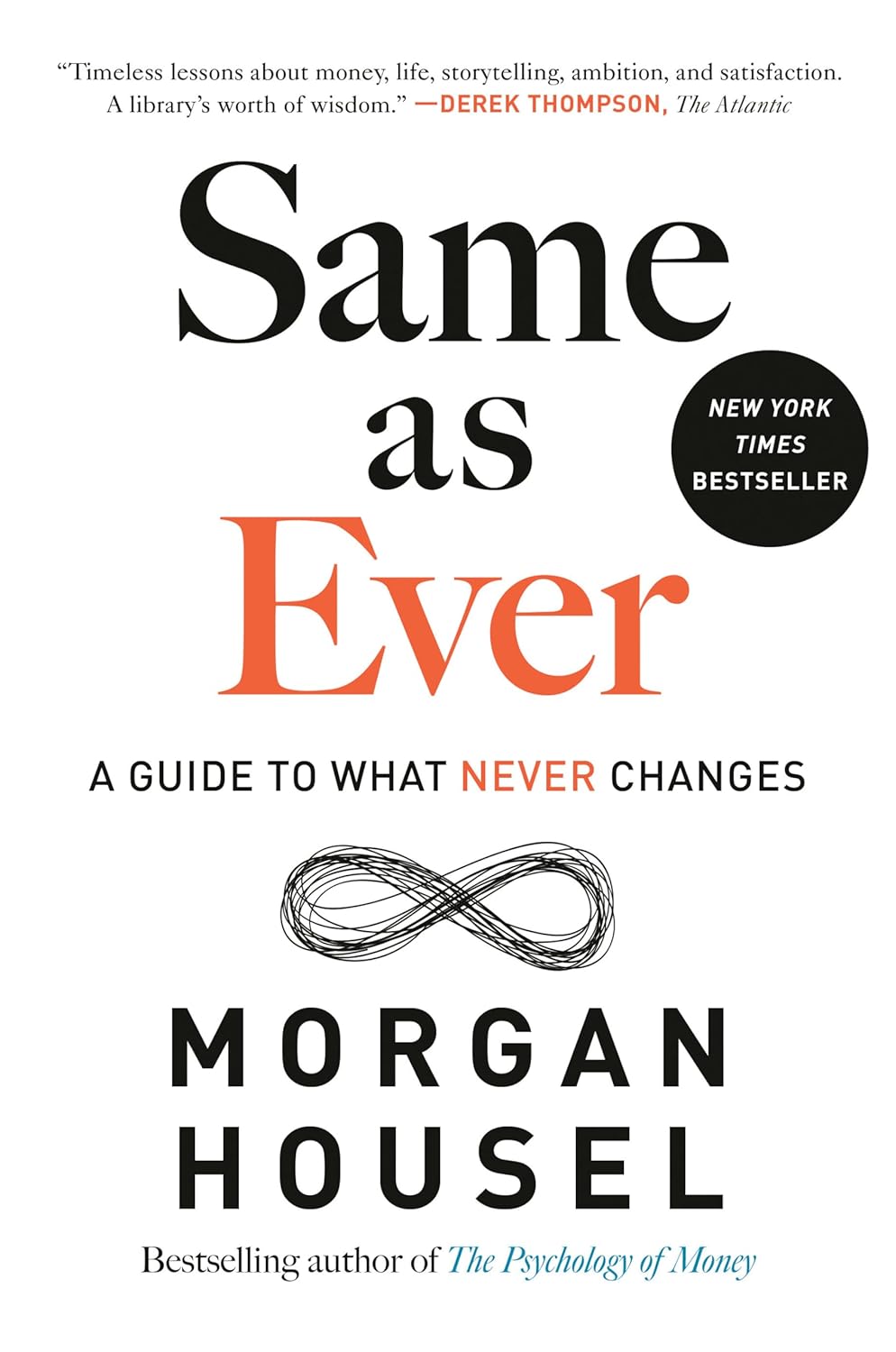
Same as Ever by Morgan Housel

Same as Ever

Morgan Housel

Format: Audio/Print Personal Score: 9.3 / 10

Things that never change are the most powerful forces in the world because you can build a strategy around them that lasts.

Essence (why this landed for me)

A book about constants. Instead of chasing what might change, focus on behaviors and principles that repeat across time. It feels practical because the controllables are clear: incentives, patience, margins, and simple rules. Short, crisp chapters make it easy to return and reuse.

Insights (mapped to mental models)

Takeaways grouped by mental models, with a short action you can use now.

People respond to incentives, always

ACTION Map who wins how.
HOW IT SHOWS UP IN THE BOOK Across eras, incentives explain behavior better than stories about virtue or villains.
MENTAL MODELS Incentives, Game Theory
MODEL CLUSTER Human Judgment & Bias

Risk never disappears, it moves

ACTION Find where it went.
HOW IT SHOWS UP IN THE BOOK Solutions shift risk from one place to another; unseen corners matter.
MENTAL MODELS Conservation of Risk, Second-Order Thinking
MODEL CLUSTER Systems & Adaptation

Most change is noise, human nature is signal

ACTION Design for defaults.
HOW IT SHOWS UP IN THE BOOK Fear, greed, envy, and pride persist, so systems must expect them.
MENTAL MODELS Base Rates, Map ≠ Territory
MODEL CLUSTER Human Judgment & Bias

Time turns small edges into big gaps

ACTION Protect compounding.
HOW IT SHOWS UP IN THE BOOK Long horizons convert average decisions into strong outcomes.
MENTAL MODELS Compounding, Exponential Effects
MODEL CLUSTER Growth & Focus

Survival beats brilliance

ACTION Add a buffer.
HOW IT SHOWS UP IN THE BOOK Staying in the game outperforms fragile outperformance.
MENTAL MODELS Margin of Safety, Redundancy
MODEL CLUSTER Systems & Adaptation

Stories persuade more than statistics

ACTION Pair data with story.
HOW IT SHOWS UP IN THE BOOK Narratives move people even when numbers are equal.
MENTAL MODELS Narrative Fallacy, Signal vs Noise
MODEL CLUSTER Human Judgment & Bias

Reversion to the mean is patient

ACTION Expect pullbacks.
HOW IT SHOWS UP IN THE BOOK Extreme outcomes tend to fade toward averages over time.
MENTAL MODELS Regression to the Mean, Base Rates
MODEL CLUSTER Logic & Reasoning

Tail events write history

ACTION Plan for tails.
HOW IT SHOWS UP IN THE BOOK A few rare events explain most outcomes in markets and life.
MENTAL MODELS Power Laws, Fat Tails
MODEL CLUSTER Systems & Adaptation

What doesn’t scale is judgment

ACTION Slow key calls.
HOW IT SHOWS UP IN THE BOOK Tools change fast; judgment changes slow and remains scarce.
MENTAL MODELS Decision Hygiene, Second-Order Thinking
MODEL CLUSTER Human Judgment & Bias

Simple rules survive regime shifts

ACTION Write three rules.
HOW IT SHOWS UP IN THE BOOK Clarity and restraint work across cycles better than complex tactics.
MENTAL MODELS Simplicity, Heuristics
MODEL CLUSTER Growth & Focus

Envy ruins more plans than adversity

ACTION Set my lane.
HOW IT SHOWS UP IN THE BOOK Comparison drives bad risk, overreach, and churn.
MENTAL MODELS Relative Utility, Opportunity Cost
MODEL CLUSTER Human Judgment & Bias

Liquidity feels like safety until it vanishes

ACTION Stress test exits.
HOW IT SHOWS UP IN THE BOOK In stress, liquidity dries up first and fastest.
MENTAL MODELS Liquidity Risk, Path Dependence
MODEL CLUSTER Systems & Adaptation

Forecast less, prepare more

ACTION Pre-commit buffers.
HOW IT SHOWS UP IN THE BOOK Preparation beats prediction because the future’s details change, not its patterns.
MENTAL MODELS Barbell Strategy, Optionality
MODEL CLUSTER Growth & Focus

Calm beats clever in compounding games

ACTION Lower turnover.
HOW IT SHOWS UP IN THE BOOK Fewer big mistakes matter more than many small optimizations.
MENTAL MODELS Error Minimization, Throughput
MODEL CLUSTER Systems & Adaptation

Focus on what won’t change

ACTION List invariants.
HOW IT SHOWS UP IN THE BOOK Work on reliability, trust, value, and service—perennials that win over time.
MENTAL MODELS Invariants, Circle of Control
MODEL CLUSTER Growth & Focus

Absorption Notes (short essay)

Build around constants. List the few things that do not change in my work and design systems that serve them. Add a margin of safety and redundancy so survival is default. Choose a long horizon and protect compounding by lowering turnover and error rate. Use simple rules I can keep in calm and stress. Expect tails and mean reversion. Plan so rare events do not end the game, and do not chase extremes when they fade. Pair data with clear stories so decisions travel. When faced with uncertainty, forecast less and prepare more: buffers, options, and clear decision rights. Keep attention on controllables and let time do its work.

Reflection Prompts (product × design × engineering)

Questions to apply the ideas across projects. Pick one or two and use them today.

Invariants

What will not change for our users in five years

Invariants

List three.

Buffers

Where do we need margin so we survive errors

Margin of Safety

Add one.

Compounding

What habit or metric compounds if I keep it steady

Compounding

Protect it.

Tails

Which tail event would break this plan

Power Laws

Barbell it.

Mean reversion

What recent extreme should I treat as temporary

Regression to the Mean

Reset expectations.

Envy check

Where am I chasing someone else’s lane

Opportunity Cost

Refocus.

Simplicity

Which rule can replace a complex policy

Heuristics

One line.

Incentives map

Who gains what from this decision

Incentives

Write payouts.

Liquidity risk

If we had to exit fast, what fails first

Liquidity Risk

Test it.

Preparation

What option or buffer can I set up today

Optionality

One step.

Quotes (anchors; verbatim)