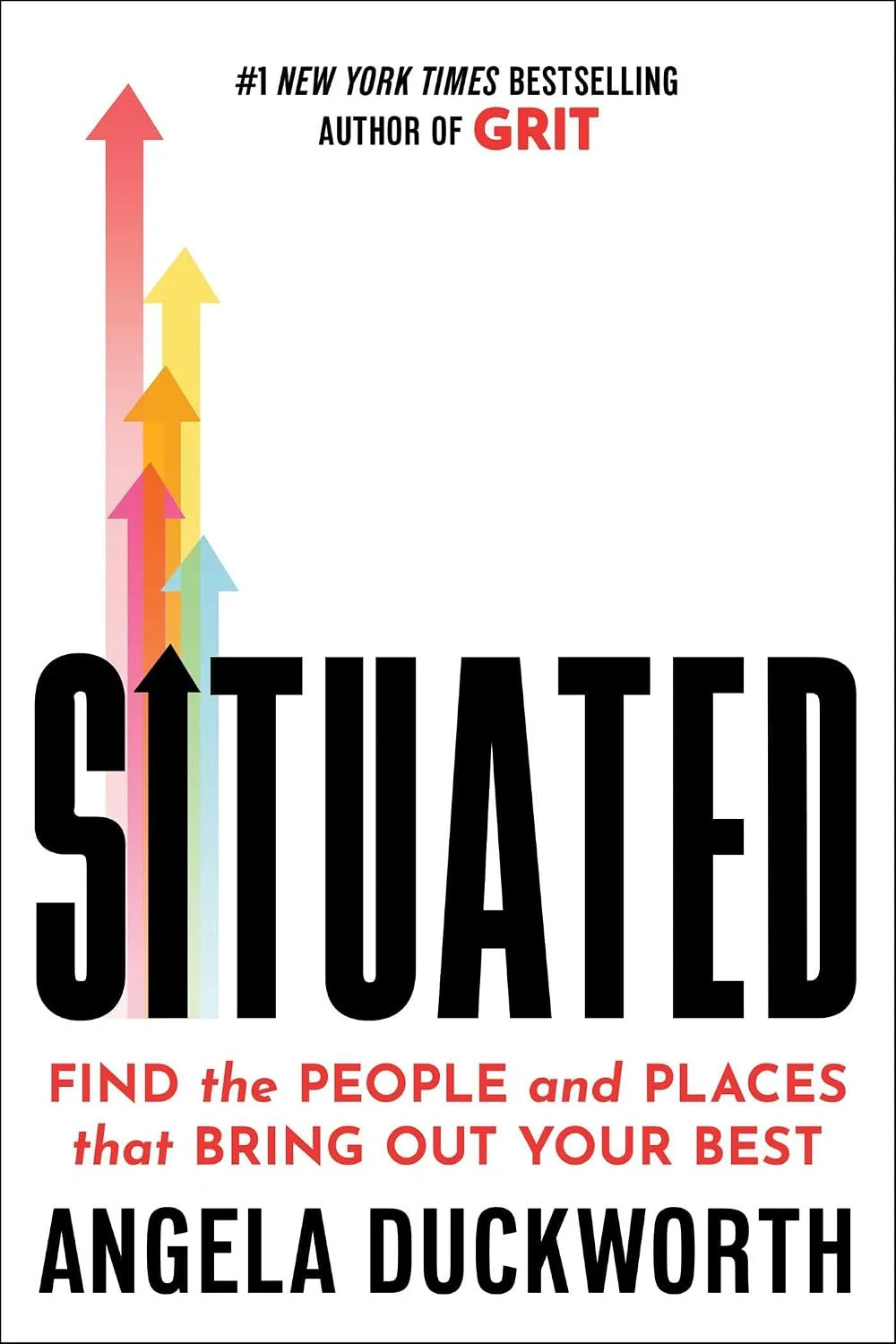
Situated: Find the People and Places That Bring Out Your Best by Angela Duckworth

Situated: Find the People and Places That Bring Out Your Best

Angela Duckworth

Format: Audio/Print Personal Score: 7.9 / 10

Design the situation first, then let grit do its work.

Essence (why this landed for me)

Willpower and grit only go so far. Duckworth's research shows the situation around us shapes what we think and do, and that gives me something concrete to rely on. The Three Boxes make it practical: the situation triggers the thoughts, and the thoughts drive the behavior. Change the trigger and the behavior follows. Her four areas, space, peers, mentors, culture, are a simple frame built on that evidence. An easy read, and a reminder to be more deliberate about the people around me, at work and at home.

Insights (mapped to mental models)

Takeaways grouped by mental models, with a short action you can use now.

Pair the want with the should so habits pay now

ACTION Bundle one reward.
HOW IT SHOWS UP IN THE BOOK Her space playbook calls it bundling: attach an immediate want to a should, because habits form on immediate reward.
MENTAL MODELS Temptation Bundling★, Incentives
MODEL CLUSTER Growth & Focus

Objects within reach quietly run my behavior

ACTION Move one temptation away.
HOW IT SHOWS UP IN THE BOOK She shows temptation is beaten by distance rather than willpower: arrange the space so the fight never starts.
MENTAL MODELS Choice Architecture★, Environment Design
MODEL CLUSTER Human Judgment & Bias

Set up the space before starting the work

ACTION Stage my desk for the task.
HOW IT SHOWS UP IN THE BOOK Her space moves: install visible cues where I will see them daily, friction up temptations, and friction down the goal by removing obstacles.
MENTAL MODELS Environment Design★, Activation Energy
MODEL CLUSTER Systems & Adaptation

The company I keep shapes the person I become

ACTION Pick my peers on purpose.
HOW IT SHOWS UP IN THE BOOK She prescribes joining or starting a group with rituals: a name, ground rules, a shared question each gathering, and peer accountability built in.
MENTAL MODELS Social Norms, Network Effects
MODEL CLUSTER Human Judgment & Bias

Mentors for a reason, a season, and for life

ACTION Ask for a curiosity conversation.
HOW IT SHOWS UP IN THE BOOK Her mentor playbook: reach out with prepared questions and a same-day thank-you, be useful to them on a project for a season, and send a gratitude letter for life.
MENTAL MODELS Leverage, Teaching as Leverage
MODEL CLUSTER Growth & Focus

Culture is a choice, and staying is one too

ACTION Question my status quo.
HOW IT SHOWS UP IN THE BOOK Her culture moves: visit a workplace before committing to it, and take a seat, any seat, on a rocket ship, because the worst job in the best culture beats the best job in the worst one.
MENTAL MODELS Status Quo Bias★, Opportunity Cost
MODEL CLUSTER Human Judgment & Bias

Personality shifts with the situation, so choose situations well

ACTION Note where I am at my best.
HOW IT SHOWS UP IN THE BOOK She shows the same person behaves differently across contexts and treats that shift as a lever to use on purpose.
MENTAL MODELS Person-Situation Fit, Self-Signaling
MODEL CLUSTER Logic & Reasoning

The easier path can be the smarter path

ACTION Take the easier route.
HOW IT SHOWS UP IN THE BOOK Taking the less effortful path can feel like cheating, and it often solves a stubborn problem the hard way never cracked.
MENTAL MODELS Inversion, Friction Reduction
MODEL CLUSTER Logic & Reasoning

High performers engineer their situations before their performances

ACTION Copy one setup ritual.
HOW IT SHOWS UP IN THE BOOK Phelps, Seinfeld, and Swift built training rooms, writing routines, and collaborator circles that made excellence the default.
MENTAL MODELS Environment Design, Deliberate Practice
MODEL CLUSTER Growth & Focus

Grit aimed at the wrong target burns the person out

ACTION Check what I am enduring.
HOW IT SHOWS UP IN THE BOOK She describes nearly gritting her way out of her marriage and into burnout; redesigning the situation was the move that worked.
MENTAL MODELS Sunk Cost Fallacy, Reframing
MODEL CLUSTER Human Judgment & Bias

Helping others starts with shaping their situation

ACTION Fix a teammate's setup.
HOW IT SHOWS UP IN THE BOOK The most effective help is rarely a pep talk: change the tools, the peers, or the room around the person.
MENTAL MODELS Leverage Points, Second-Order Thinking
MODEL CLUSTER Systems & Adaptation

Everybody is trying; situations separate the outcomes

ACTION Audit the setup, then judge.
HOW IT SHOWS UP IN THE BOOK Her five-year-old cut through it at bedtime: everybody is doing the best they can. Effort is common; well-designed situations are rare.
MENTAL MODELS Fundamental Attribution Error★, Base Rates
MODEL CLUSTER Human Judgment & Bias

The zip code is part of the plan

ACTION Weigh place in decisions.
HOW IT SHOWS UP IN THE BOOK She points to concrete tools: look up the address on Opportunity Atlas, check Walk Score, and treat moving even a few miles as a real lever.
MENTAL MODELS Environment Design, Path Dependence
MODEL CLUSTER Systems & Adaptation

Trace the habit back to its triggering situation

ACTION Run the Three Boxes.
HOW IT SHOWS UP IN THE BOOK The Three Boxes Blueprint reverse-engineers behavior from right to left: response, the thoughts behind it, then the situation that triggers those thoughts; change starts in box one.
MENTAL MODELS Root Cause Analysis★, Feedback Loops
MODEL CLUSTER Logic & Reasoning

Half of good plans flop, so try the next nudge

ACTION Test another nudge.
HOW IT SHOWS UP IN THE BOOK She warns that about half of well-conceived situation changes fail because nudges are hard to predict; the move is to try, watch, and adjust.
MENTAL MODELS Experiment Design, Bayesian Updating
MODEL CLUSTER Systems & Adaptation

Make the situation better before making the best of it

ACTION Improve one condition today.
HOW IT SHOWS UP IN THE BOOK The book's through line inverts the familiar advice: redesign comes before resilience.
MENTAL MODELS Inversion★, First Principles
MODEL CLUSTER Logic & Reasoning

Absorption Notes (short essay)

When a task keeps slipping, run the Three Boxes: what is the situation, what thoughts does it trigger, and what do I end up doing. Then flip it: what change in the situation would trigger better thoughts. Half of these changes will flop. Try another one. Keep temptations out of sight and out of reach. Clear one obstacle from the goal I care about. Pair something I enjoy with something I should do. Find or start a small group around a shared interest and meet on a steady rhythm. When I want to learn from someone, ask for a short conversation, come prepared, and thank them with specifics the next day. Once a year, write a proper thank-you to a mentor. Simple moves, steady rhythm.

Reflection Prompts (product × design × engineering)

Questions to apply the ideas across projects. Pick one or two and use them today.

Situation audit

Which situation in my week reliably brings out my best and which does the opposite

Person-Situation Fit

Name both.

Arm's reach

What sits within reach that pulls me away from the priority

Choice Architecture

Move it.

Five people

Who are the five people I spend the most time with and where do they pull me

Social Norms

List them.

Mentor

Who am I learning from on purpose right now

Leverage

Ask one.

Status quo

Would I choose this team, role, or routine again if starting fresh

Status Quo Bias

Decide fresh.

Easier path

Where am I grinding when a redesign would dissolve the problem

Friction Reduction

Redesign it.

Best self

In which room, time, or company am I most like the person I want to be

Environment Design

Go there more.

Help design

Whose situation could I improve this week instead of giving advice

Leverage Points

Change their room.

Attribution

Am I judging someone's effort when their situation is the real story

Fundamental Attribution Error

Check the setup.

Place

Is where I live and work serving what I am building

Path Dependence

Weigh the place.

Quotes (anchors; verbatim)