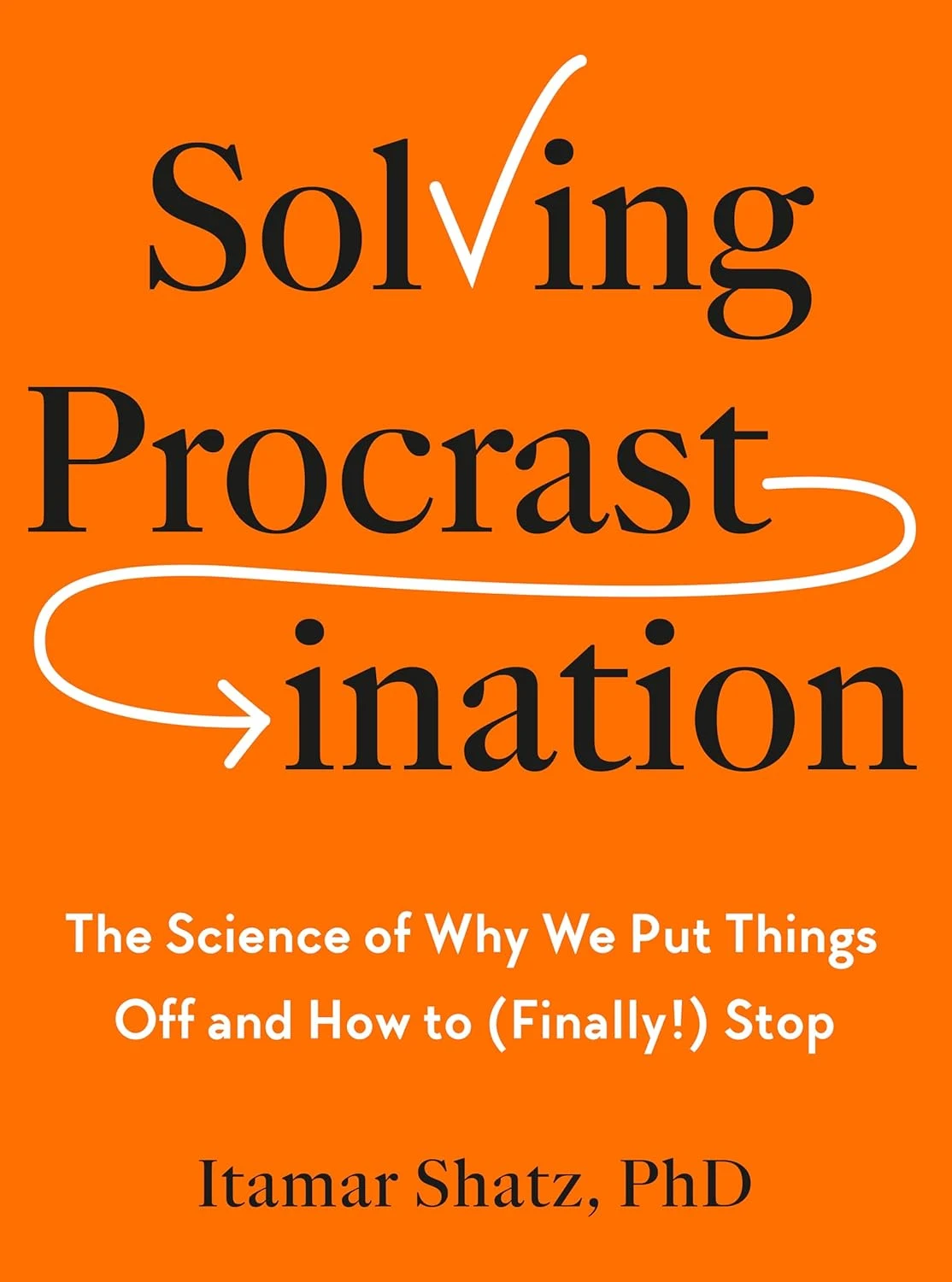
Solving Procrastination: The Science of Why We Put Things Off and How to (Finally!) Stop by Itamar Shatz

Solving Procrastination: The Science of Why We Put Things Off and How to (Finally!) Stop

Itamar Shatz

Format: Audio/Print Personal Score: 6.8 / 10

The fight is between feeling good now and doing good later.

Essence (why this landed for me)

A causes-first look at why things get delayed. The core frame: delay is about escaping a feeling now, not about managing time, and the fix should match the cause. The diagnosis questions, what I delay, how, when, and why, are the part I want to keep. The toolkit, friction, environment design, tiny first steps, if-then plans, connects well with Situated and The Friction Project.

Insights (mapped to mental models)

Takeaways grouped by mental models, with a short action you can use now.

Procrastination is mood repair, not time management

ACTION Name the feeling first.
HOW IT SHOWS UP IN THE BOOK He frames delay as giving in to feel good: the task gets postponed to escape a feeling, not because the calendar is wrong.
MENTAL MODELS Emotion Regulation, Root Cause Analysis★
MODEL CLUSTER Human Judgment & Bias

Two drives are in a tug-of-war

ACTION Weigh both drives.
HOW IT SHOWS UP IN THE BOOK His model sets a drive to act, self-control plus motivation, against a drive to delay; delay wins whenever it is irrationally stronger.
MENTAL MODELS System 1 ↔ System 2★, Incentives
MODEL CLUSTER Logic & Reasoning

Now beats later because feelings arrive before outcomes

ACTION Bring the outcome closer.
HOW IT SHOWS UP IN THE BOOK The hedonic principle and the immediacy principle combine to push toward whatever feels better right now instead of what pays later.
MENTAL MODELS Temporal Discounting★, Second-Order Thinking
MODEL CLUSTER Human Judgment & Bias

Diagnose the delay before picking a cure

ACTION Run the what-how-when-why.
HOW IT SHOWS UP IN THE BOOK His assessment asks what I delay, how I escape it, where and when it happens, and why, then matches techniques to the cause.
MENTAL MODELS Diagnosis Before Prescription, Root Cause Analysis★
MODEL CLUSTER Logic & Reasoning

Archetypes are causes wearing faces

ACTION Name my archetype.
HOW IT SHOWS UP IN THE BOOK Nine types, Worrier to Burnout, each map a different cause: fear, perfectionism, vague dreams, novelty seeking, or depletion, and one person can be several.
MENTAL MODELS Clustering, Pattern Recognition
MODEL CLUSTER Logic & Reasoning

The tiniest first step beats the perfect plan

ACTION Commit to two minutes.
HOW IT SHOWS UP IN THE BOOK His quick-start is three moves: one tiny step, tools prepared in advance, and distractions removed before willpower is ever needed.
MENTAL MODELS Activation Energy★, MVP
MODEL CLUSTER Growth & Focus

Friction works in both directions

ACTION Move one temptation away.
HOW IT SHOWS UP IN THE BOOK Make the task easier to start and the distraction harder to reach; precommitment devices attach a cost to giving in.
MENTAL MODELS Choice Architecture★, Commitment Devices
MODEL CLUSTER Systems & Adaptation

If-then plans decide before the moment does

ACTION Write one if-then.
HOW IT SHOWS UP IN THE BOOK Implementation intentions pre-wire the response, if it is 9 am then I open the draft, so the decision is already made when the moment arrives.
MENTAL MODELS Implementation Intentions, Precommitment
MODEL CLUSTER Systems & Adaptation

Vague goals are delay generators

ACTION Make the goal concrete.
HOW IT SHOWS UP IN THE BOOK Abstract goals sit among his top causes, and setting specific, realistic goals is step one of the whole method.
MENTAL MODELS Goal Setting, Map ≠ Territory
MODEL CLUSTER Growth & Focus

Self-compassion restarts what guilt keeps stalled

ACTION Drop the self-blame.
HOW IT SHOWS UP IN THE BOOK Procrastination cycles run on anxiety and shame about past delays; he treats self-compassion and permission to make mistakes as working tools.
MENTAL MODELS Feedback Loops, Self-Compassion
MODEL CLUSTER Human Judgment & Bias

Deadlines work when near, concrete, and meaningful

ACTION Set a middle deadline.
HOW IT SHOWS UP IN THE BOOK He favors intermediate and ultra-short deadlines over one distant date, so the future stops being abstract.
MENTAL MODELS Commitment Devices★, Parkinson's Law
MODEL CLUSTER Systems & Adaptation

Treat the condition, not just the habit

ACTION Check what is underneath.
HOW IT SHOWS UP IN THE BOOK ADHD, depression, burnout, and sleep debt weaken the drive to act; no technique list substitutes for treating them.
MENTAL MODELS Bottlenecks, First Principles
MODEL CLUSTER Systems & Adaptation

The future self is a stranger until visited

ACTION Picture the future me.
HOW IT SHOWS UP IN THE BOOK Temporal disjunction treats future consequences as someone else's problem; episodic future thinking, picturing that self concretely, closes the gap.
MENTAL MODELS Long-Term Orientation, Inversion
MODEL CLUSTER Human Judgment & Bias

Absorption Notes (short essay)

When something keeps slipping, try one of these: put it in peak hours before email and admin, timebox thirty minutes for it, stage it the night before so starting takes one action, or shrink it to a tiny first step. For a parked project, try a ship date someone else knows about, a middle milestone, or a short window with a visible end. For an avoided decision, try booking the half hour to make the call, ranking it first on tomorrow's list of six, or asking someone to hold me to a date. Before any of these, check once whether the delay is deliberate sequencing; some waiting is judgment, not avoidance. Keep the author's two sites, solvingprocrastination.com and effectiviology.com, bookmarked: the technique lists and the specialized guides there go deeper when a particular kind of delay needs its own fix. Simple moves, steady rhythm.

Reflection Prompts (product × design × engineering)

Questions to apply the ideas across projects. Pick one or two and use them today.

Feeling

What feeling am I avoiding by not starting this

Emotion Regulation

Name it.

Diagnose

What am I delaying, how, when, and why

Root Cause Analysis

Four lines.

Tiny step

What two-minute version of this task can I start now

Activation Energy

Start it.

Friction

What is one click too easy and what is one click too hard

Choice Architecture

Swap them.

If-then

Which recurring moment deserves a pre-wired response

Implementation Intentions

Write the rule.

Concrete

Is this goal specific enough that I would know when to start

Goal Setting

Sharpen it.

Middle date

What intermediate deadline would make the far one real

Commitment Devices

Set one.

Cycle

Where is guilt about past delay feeding the next delay

Feedback Loops

Restart small.

Future me

What does the person finishing this look like in six months

Long-Term Orientation

Picture it.

Underneath

Is low energy or something deeper weakening the drive to act

Bottlenecks

Check the base.

Quotes (anchors; verbatim)