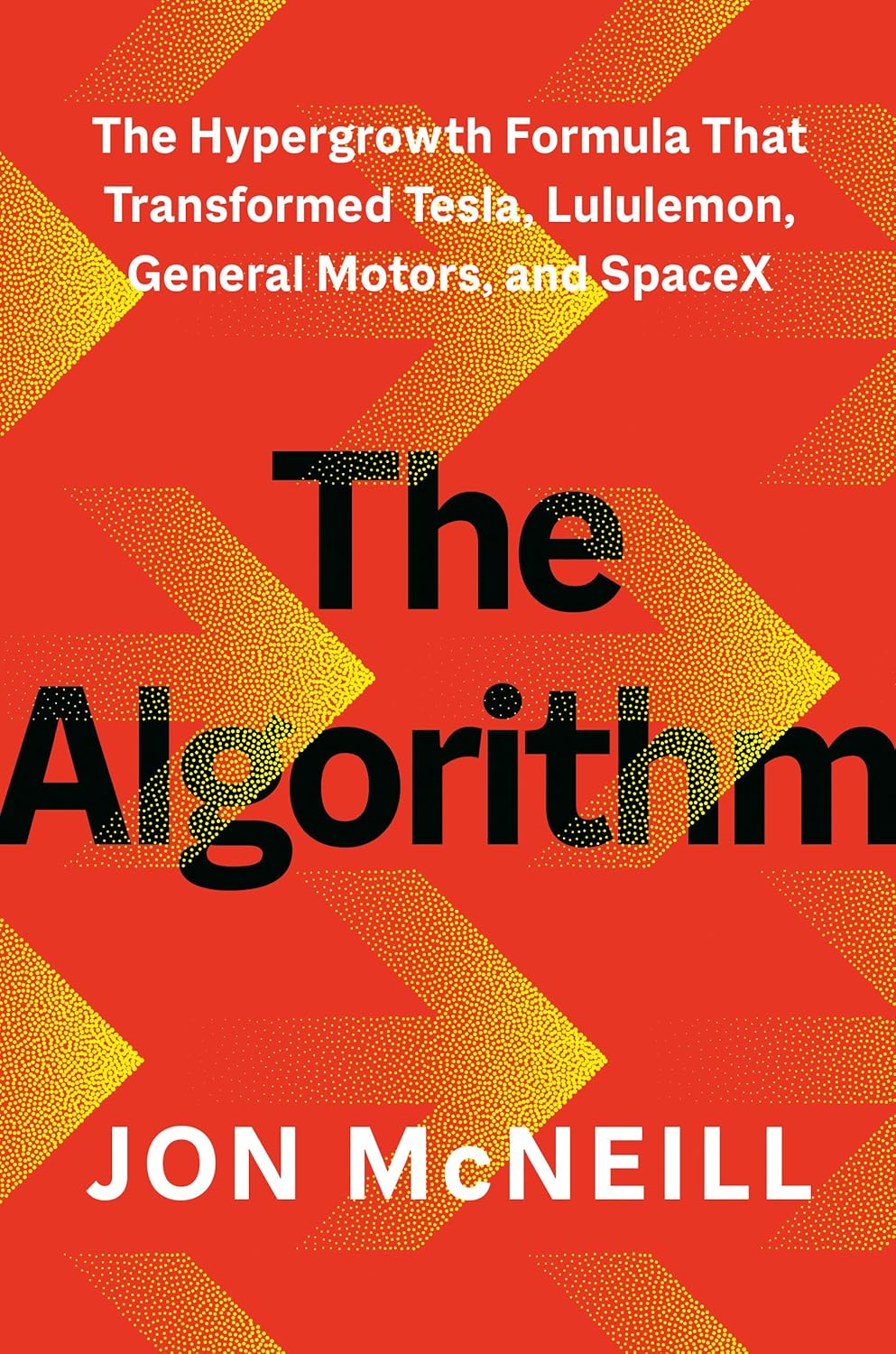
The Algorithm: The Hypergrowth Formula That Transformed Tesla, Lululemon, General Motors, and SpaceX by Jon McNeill

The Algorithm: The Hypergrowth Formula That Transformed Tesla, Lululemon, General Motors, and SpaceX

Jon McNeill

Format: Audio/Print Personal Score: 9.4 / 10

Growth comes from what you remove, not what you add.

Essence (why this landed for me)

A companion to The Book of Elon, but from the person who ran The Algorithm day-to-day inside Tesla. Where Musk's words gave the philosophy, this book gave me the operational playbook: five steps, in strict order, applied across industries and team sizes. The case studies made it concrete enough to use tomorrow, and the message landed: simplification, not addition, is the unfair advantage.

Insights (mapped to mental models)

Takeaways grouped by mental models, with a short action you can use now.

The order matters more than the steps themselves

ACTION Check my step order.
HOW IT SHOWS UP IN THE BOOK Tesla's $1 billion alien Dreadnought mistake happened because they automated first. The tent-built Model 3s proved that manual understanding must come before automation.
MENTAL MODELS Sequencing ★, Second-Order Thinking
MODEL CLUSTER Systems & Adaptation

Question every requirement by name and rank

ACTION Name who owns the rule.
HOW IT SHOWS UP IN THE BOOK Each requirement must have a specific person's name attached. Requirements from smart people are the most dangerous because no one questions them.
MENTAL MODELS First Principles ★, Authority Bias
MODEL CLUSTER Logic & Reasoning

If you are not adding back 10%, delete harder

ACTION Delete one more thing.
HOW IT SHOWS UP IN THE BOOK The deletion test: if you are not adding back at least 10% of what you deleted, you did not delete enough.
MENTAL MODELS Subtraction ★, Via Negativa
MODEL CLUSTER Logic & Reasoning

Never optimize a step that should not exist

ACTION Ask if this step should exist.
HOW IT SHOWS UP IN THE BOOK McNeill calls this the most common mistake: teams polish and speed up processes that have no reason to be there in the first place.
MENTAL MODELS First Principles, Occam's Razor ★
MODEL CLUSTER Logic & Reasoning

Simplification is an unfair advantage few will pursue

ACTION Simplify before I add.
HOW IT SHOWS UP IN THE BOOK Everybody can complicate, but very few can simplify. McNeill frames the ability to simplify as a competitive moat because organizations are allergic to radical simplification.
MENTAL MODELS Moats, Occam's Razor ★
MODEL CLUSTER Growth & Focus

Cash velocity tells you how well the system runs

ACTION Measure my cash velocity.
HOW IT SHOWS UP IN THE BOOK Tesla's manufacturing cycle was 14 days versus Toyota's 4. Toyota required one-third less working capital for equivalent output. McNeill learned this metric from Toyota and applied it at Tesla.
MENTAL MODELS Leading Indicators ★, Throughput
MODEL CLUSTER Systems & Adaptation

Expand the product to the entire customer experience

ACTION Map my full customer journey.
HOW IT SHOWS UP IN THE BOOK At Tesla, the product was not the car. It was the entire experience from purchase through service, including the Supercharger network.
MENTAL MODELS Systems Thinking ★, Customer-Centric Design
MODEL CLUSTER Systems & Adaptation

Make them talk about you at dinner tonight

ACTION Apply the dinner table test.
HOW IT SHOWS UP IN THE BOOK McNeill replaced Tesla's 20-hour training manuals with a single principle: every customer interaction should be remarkable enough that the customer tells someone about it at dinner.
MENTAL MODELS Simplicity ★, Word of Mouth
MODEL CLUSTER Growth & Focus

Speed exposes hidden flaws that comfort conceals

ACTION Accelerate one cycle this week.
HOW IT SHOWS UP IN THE BOOK McNeill rejects the good/fast/cheap tradeoff. Accelerating cycle time at Tesla forced hidden problems to surface that would have stayed buried at a slower pace.
MENTAL MODELS Feedback Loops ★, Tempo
MODEL CLUSTER Systems & Adaptation

Automate last or you will pay for it twice

ACTION Work it manually first.
HOW IT SHOWS UP IN THE BOOK The alien Dreadnought factory automated before the process was understood. Tesla spent $1 billion, then had to build cars in a parking lot tent. Amazon and DoorDash both worked manually first to prevent locking in flawed systems.
MENTAL MODELS Second-Order Thinking ★, Sunk Cost Fallacy
MODEL CLUSTER Logic & Reasoning

To make the quarter, first make the day

ACTION Set my daily target.
HOW IT SHOWS UP IN THE BOOK McNeill's execution cascade: to make your quarter, make your month. To make your month, make your week. To make your week, make your day.
MENTAL MODELS Leading Indicators, Compounding ★
MODEL CLUSTER Growth & Focus

Lean improves what exists, The Algorithm questions if it should

ACTION Ask should this exist.
HOW IT SHOWS UP IN THE BOOK McNeill was trained in Toyota's lean principles, which optimize existing systems. The Algorithm is the antithesis: radical rethinking that explodes the status quo rather than polishing it.
MENTAL MODELS First Principles ★, Paradigm Shift
MODEL CLUSTER Logic & Reasoning

Use your own product or you will never see clearly

ACTION Experience what my customer does.
HOW IT SHOWS UP IN THE BOOK When McNeill joined Lyft, he gave up his car for a month. At Tesla, he secret-shopped eight stores and found zero callbacks.
MENTAL MODELS Empathy Mapping ★, Skin in the Game
MODEL CLUSTER Human Judgment & Bias

Urgency without accountability is just noise

ACTION Name the two things that matter.
HOW IT SHOWS UP IN THE BOOK McNeill identifies the two or three things that matter at any given time and reviews them weekly. Not punishment-based, but radical transparency about what works and what fails.
MENTAL MODELS Focus ★, Radical Candor
MODEL CLUSTER Growth & Focus

Absorption Notes (short essay)

Start with The Algorithm's strict order on the next process review I run. Step one: list every requirement and name who owns it. If it came from a department, push for a person. Step two: try to delete it. If I am not re-adding at least 10% later, I was too cautious. Step three: simplify what survived. Only then accelerate and automate. Run the dinner table test on every customer touchpoint: would a customer tell someone about this tonight. Measure cash velocity monthly. When setting quarterly targets, break them into daily milestones and track the cascade. Spend at least one day a month using my own product the way a customer does. When something feels too complex, remember: everybody can complicate, but simplification is the real edge. Simple moves, steady rhythm.

Reflection Prompts (product x design x engineering)

Questions to apply the ideas across projects. Pick one or two and use them today.

Order

Am I following The Algorithm's five steps in the right sequence or skipping ahead

Sequencing

Check the order.

Requirement

Which requirement am I accepting without knowing who specifically created it

First Principles

Name the person.

Delete

What process or step can I try to delete entirely this week

Subtraction

Remove one thing.

Simplify

Where am I optimizing something that should not exist in the first place

Occam's Razor

Question its existence.

Automate

Am I automating before I understand the process manually

Second-Order Thinking

Work it by hand.

Cash velocity

How fast does value move through my operation and what is slowing it down

Throughput

Find the drag.

Dinner table

Would my customer tell someone about their experience with us tonight

Word of Mouth

Test the moment.

Product scope

Am I defining my product too narrowly and missing the full customer experience

Systems Thinking

Expand the frame.

Daily cascade

What is the one thing I need to accomplish today to stay on track for the quarter

Leading Indicators

Set today's target.

Dog food

When did I last use my own product the way a customer does

Empathy Mapping

Try it myself.

Quotes (anchors; verbatim)