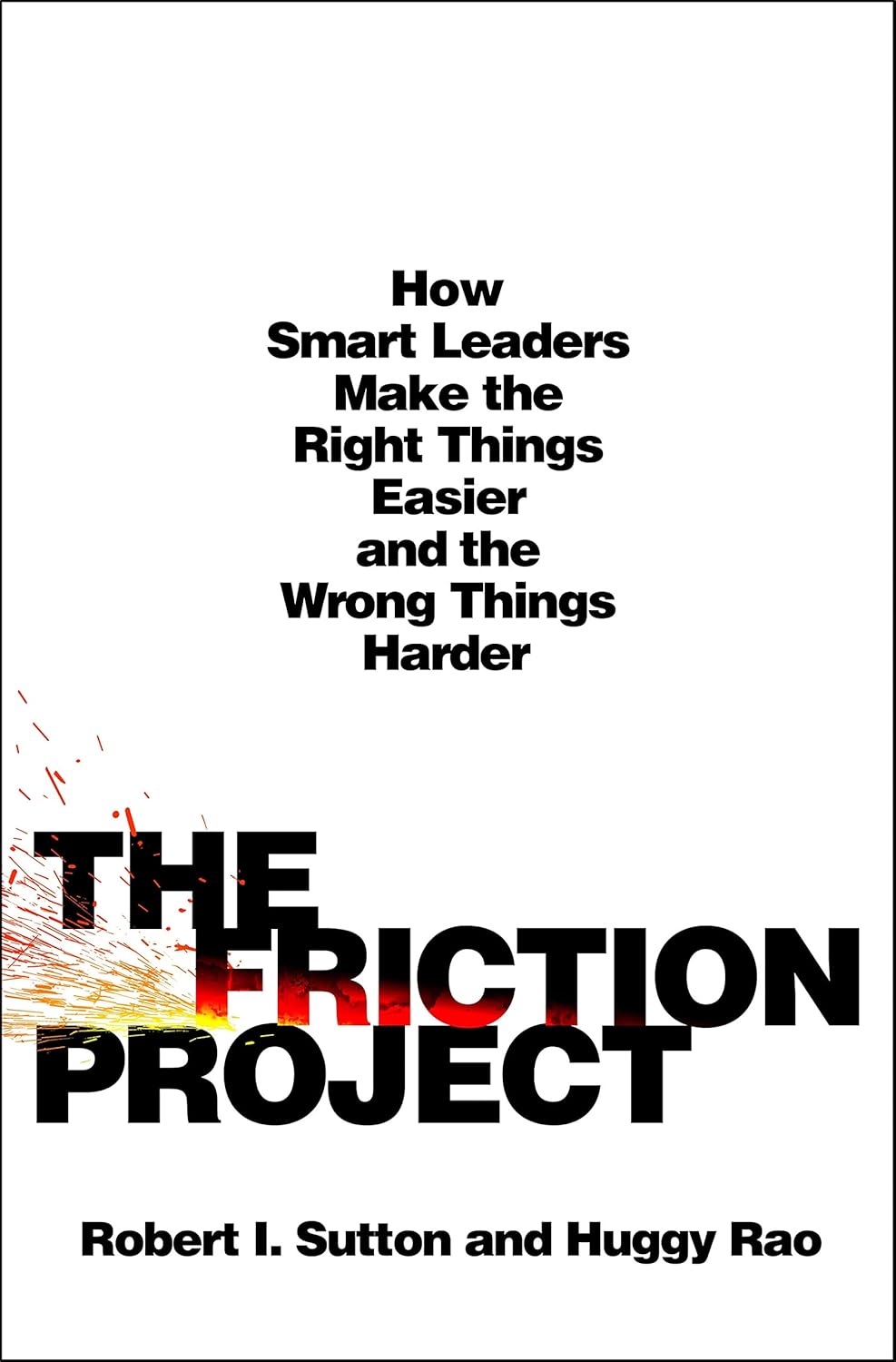
The Friction Project by Bob Sutton & Huggy Rao

The Friction Project

Bob Sutton & Huggy Rao

Format: Audio/Print Personal Score: 8.3 / 10

Remove what wastes time; make the right thing easy.

Essence (why this landed for me)

This book gave me a clear role to play: friction fixer. It showed how subtraction, not addition, often moves work faster. I like the tools that make good actions effortless and bad ones harder. It feels useful in teams and in daily life.

Insights (mapped to mental models)

Takeaways grouped by mental models, with a short action you can use now.

Subtraction is a strategy, not an afterthought

ACTION Kill one step.
HOW IT SHOWS UP IN THE BOOK The authors push deliberate removal of rules, forms, and meetings to speed progress.
MENTAL MODELS Inversion, Simplicity
MODEL CLUSTER Logic & Reasoning

Make the right thing the easy thing

ACTION Lower one friction.
HOW IT SHOWS UP IN THE BOOK They focus on default paths, templates, and shortcuts that reduce effort for desired behavior.
MENTAL MODELS Choice Architecture, Path of Least Resistance
MODEL CLUSTER Systems & Adaptation

Name the time thieves before you fight them

ACTION List three thieves.
HOW IT SHOWS UP IN THE BOOK They surface common drains like needless approvals, unclear owners, and bloated meetings.
MENTAL MODELS Bottlenecks, Opportunity Cost
MODEL CLUSTER Growth & Focus

Flow improves when you shrink batch size

ACTION Cut batch in half.
HOW IT SHOWS UP IN THE BOOK Smaller chunks reduce waiting, errors, and rework.
MENTAL MODELS Queuing Theory, Throughput
MODEL CLUSTER Systems & Adaptation

Checklists prevent known mistakes

ACTION Add a one-pager.
HOW IT SHOWS UP IN THE BOOK Simple, visible checklists remove avoidable errors and decision fatigue.
MENTAL MODELS Checklists, Error Minimization
MODEL CLUSTER Logic & Reasoning

Stop-doing lists free more time than to-do lists

ACTION Drop one ritual.
HOW IT SHOWS UP IN THE BOOK They recommend explicit elimination of low-value habits.
MENTAL MODELS Inversion★, Opportunity Cost
MODEL CLUSTER Growth & Focus

Friction can be a feature for risky actions

ACTION Add one speed bump.
HOW IT SHOWS UP IN THE BOOK Introduce extra steps where harms are costly to slow bad moves.
MENTAL MODELS Risk Management, Guardrails
MODEL CLUSTER Systems & Adaptation

Clear ownership removes coordination drag

ACTION Name the owner.
HOW IT SHOWS UP IN THE BOOK Single-threaded leaders and RACI clarity reduce loops and stalls.
MENTAL MODELS Role Clarity, Decision Rights
MODEL CLUSTER Human Judgment & Bias

Map the journey to see hidden friction

ACTION Sketch the path.
HOW IT SHOWS UP IN THE BOOK Service maps expose handoffs, waits, and duplicate steps.
MENTAL MODELS Systems Thinking, Process Mapping
MODEL CLUSTER Systems & Adaptation

Meetings need gates or they multiply

ACTION Gate every meeting.
HOW IT SHOWS UP IN THE BOOK Require a purpose, agenda, pre-read, and an owner—or cancel.
MENTAL MODELS Constraints → Creativity, Goodhart’s Guardrail
MODEL CLUSTER Growth & Focus

Tripwires catch drift early

ACTION Set one trigger.
HOW IT SHOWS UP IN THE BOOK Predefined signals force a pause or pivot before waste grows.
MENTAL MODELS Leading Indicators, Threshold Effects
MODEL CLUSTER Systems & Adaptation

Defaults are powerful policy

ACTION Fix one default.
HOW IT SHOWS UP IN THE BOOK Set opt-in/opt-out and prefilled fields to steer behavior.
MENTAL MODELS Default Effects, Choice Architecture★
MODEL CLUSTER Human Judgment & Bias

Fewer handoffs, fewer headaches

ACTION Shorten the chain.
HOW IT SHOWS UP IN THE BOOK Reducing cross-team passes cuts latency and loss of context.
MENTAL MODELS Interface Design, Transaction Costs
MODEL CLUSTER Systems & Adaptation

Error-proof the step that fails most

ACTION Poka-yoke one step.
HOW IT SHOWS UP IN THE BOOK Design inputs and forms to prevent common mistakes.
MENTAL MODELS Poka-Yoke, Feedback Loops
MODEL CLUSTER Logic & Reasoning

Measure friction by outcomes, not feelings

ACTION Track cycle time.
HOW IT SHOWS UP IN THE BOOK Use time-to-complete, rework rates, and dropped steps as the score.
MENTAL MODELS Decision Hygiene, Signal vs Noise
MODEL CLUSTER Growth & Focus

Sometimes the fix is to add a buffer

ACTION Add slack where needed.
HOW IT SHOWS UP IN THE BOOK Small reserves in high-variance steps prevent cascades.
MENTAL MODELS Margin of Safety, Second-Order Thinking
MODEL CLUSTER Systems & Adaptation

Absorption Notes (short essay)

Work like a friction fixer. List the biggest time thieves and remove one each week. Map the path from request to delivery and cut steps, handoffs, and batch size. Add a one-page checklist where errors repeat. Set gates for meetings and approvals so they do not grow by habit. Use defaults and templates to make good actions easy. Add a speed bump only where risk is high. Track cycle time and rework, not vibes. Keep the changes small but steady.

Reflection Prompts (product × design × engineering)

Questions to apply the ideas across projects. Pick one or two and use them today.

Time thieves

What wastes the most time on this path

Bottlenecks

List three.

Subtraction

Which step can we remove with no downside

Inversion

Kill one.

Batch size

How can we deliver in smaller chunks

Queuing Theory

Halve it.

Ownership

Who is the single owner for the next step

Role Clarity

Name one.

Defaults

What default would steer the right behavior

Choice Architecture

Set it.

Poka-yoke

Where do we see the same error and how to prevent it

Error Minimization

Design it out.

Meeting gate

Does this meeting have a purpose, agenda, and pre-read

Constraints → Creativity

Cancel if not.

Tripwire

What signal should force a pause or pivot

Threshold Effects

Define one.

Handoffs

Which handoff can we remove or merge

Transaction Costs

Shorten chain.

Slack

Where will a small buffer prevent a big failure

Margin of Safety

Add it.