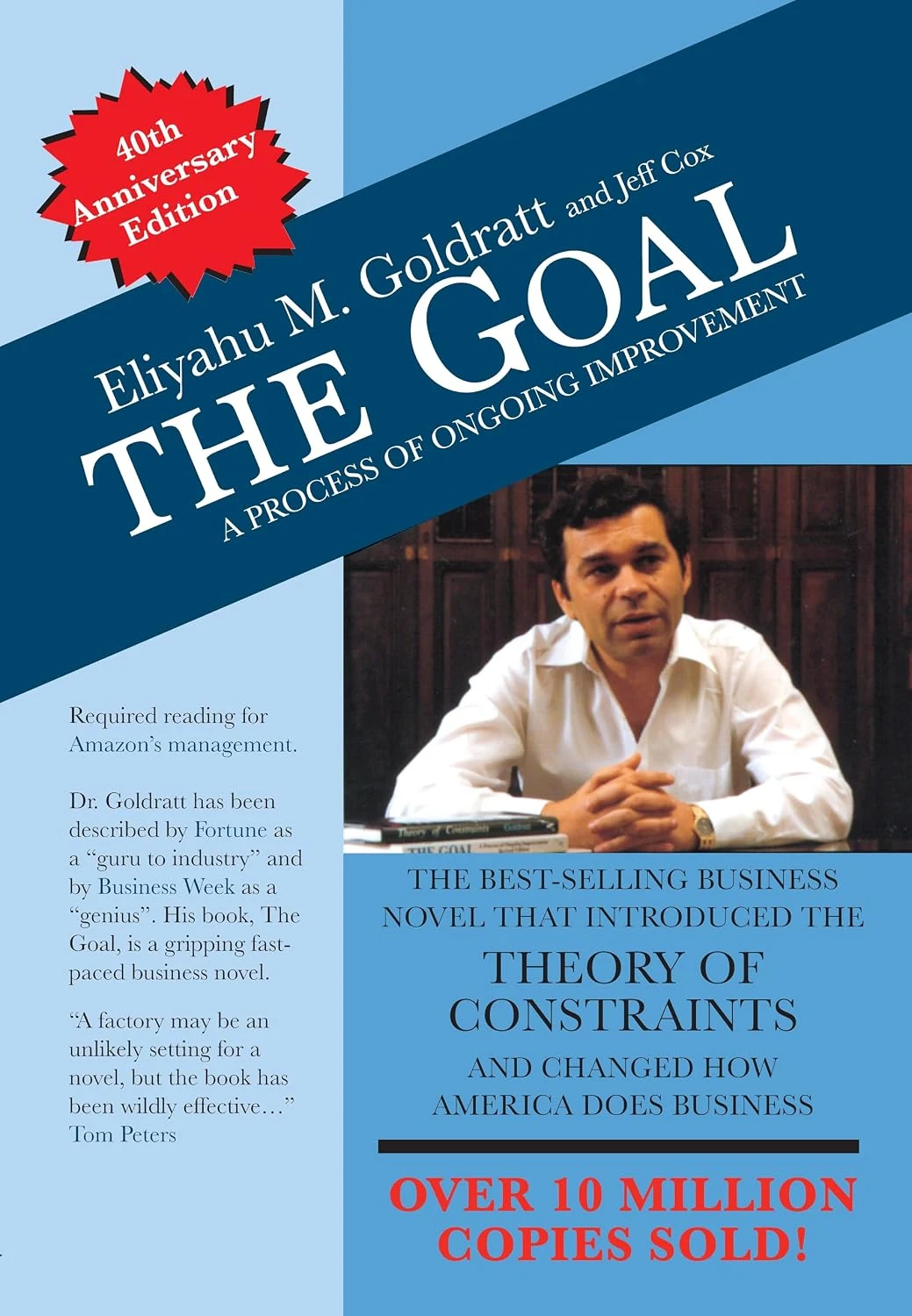
The Goal: A Process of Ongoing Improvement by Eliyahu M. Goldratt, Jeff Cox

The Goal: A Process of Ongoing Improvement

Eliyahu M. Goldratt, Jeff Cox

Format: Audio/Print Personal Score: 8.2 / 10

Busy everywhere is not the same as moving anywhere.

Essence (why this landed for me)

Inside the Box sent me here, and the detour paid off. A business novel from 1984 that reads fast and teaches one thing deeply: the bottleneck sets the pace of the whole system, so everything else should serve it. The Herbie hike made it stick, the slowest scout decides when the troop arrives. It changed how I look at busy teams: high utilization everywhere can mean the system is barely moving. Forty years on, the questions still fit product, design, and engineering work.

Insights (mapped to mental models)

Takeaways grouped by mental models, with a short action you can use now.

Name the goal before measuring anything else

ACTION Write the goal first.
HOW IT SHOWS UP IN THE BOOK Alex's plant looks efficient by every local metric while losing money; Jonah's opening question is what the goal of the company actually is.
MENTAL MODELS First Principles★, Goals vs Metrics
MODEL CLUSTER Logic & Reasoning

Three numbers tell the truth about a system

ACTION Map my three numbers.
HOW IT SHOWS UP IN THE BOOK Jonah replaces cost accounting with throughput, money coming in through sales, inventory, money stuck inside the system, and operating expense, money spent turning one into the other.
MENTAL MODELS Measurement, Signal vs Noise
MODEL CLUSTER Logic & Reasoning

The bottleneck sets the pace of the whole system

ACTION Find my Herbie.
HOW IT SHOWS UP IN THE BOOK On the scout hike the troop arrives when Herbie arrives, so Alex puts him at the front of the line and lightens his pack.
MENTAL MODELS Bottlenecks★, Throughput
MODEL CLUSTER Systems & Adaptation

An hour lost at the bottleneck is lost forever

ACTION Keep the bottleneck fed.
HOW IT SHOWS UP IN THE BOOK The plant staggers lunch breaks at the NCX-10 and moves quality checks in front of it so the constraint never sits idle or works on defective parts.
MENTAL MODELS Opportunity Cost, Leverage Points★
MODEL CLUSTER Systems & Adaptation

Efficiency at a non-bottleneck is a mirage

ACTION Stop polishing non-bottlenecks.
HOW IT SHOWS UP IN THE BOOK Speeding up steps that are not the constraint does not raise output; it just piles inventory in front of the step that is.
MENTAL MODELS Local vs Global Optima, Goodhart's Law
MODEL CLUSTER Logic & Reasoning

A plant where everyone is always busy is inefficient

ACTION Allow idle time on purpose.
HOW IT SHOWS UP IN THE BOOK Jonah argues that a balanced plant, capacity trimmed to match demand everywhere, marches toward bankruptcy because fluctuations only accumulate downstream.
MENTAL MODELS Slack, Margin of Safety
MODEL CLUSTER Systems & Adaptation

Dependent events amplify statistical fluctuations

ACTION Trace the dependency chain.
HOW IT SHOWS UP IN THE BOOK The dice and matchstick game shows that in a chain of steps, delays pass downstream while gains do not average out.
MENTAL MODELS Queuing Theory, Second-Order Thinking
MODEL CLUSTER Systems & Adaptation

Exploit the constraint before spending to elevate it

ACTION Squeeze what I have first.
HOW IT SHOWS UP IN THE BOOK Before buying capacity, the team brings back the old Zmegma machines, reroutes work, and offloads the bottleneck; money comes out only after the cheap moves are exhausted.
MENTAL MODELS Sequencing★, Resourcefulness
MODEL CLUSTER Growth & Focus

Cut the batch and the whole system speeds up

ACTION Halve one batch size.
HOW IT SHOWS UP IN THE BOOK Halving batch sizes cuts lead time, frees cash from inventory, and lets the plant promise faster deliveries and win new orders.
MENTAL MODELS Queuing Theory★, Feedback Loops
MODEL CLUSTER Systems & Adaptation

Drum, buffer, rope keeps the flow honest

ACTION Pace releases to the constraint.
HOW IT SHOWS UP IN THE BOOK Material is released to the rhythm of the bottleneck, the drum, protected by a time buffer, and tied back by a rope so work in process cannot balloon.
MENTAL MODELS Systems Thinking, Process Control
MODEL CLUSTER Systems & Adaptation

Measurements drive behavior more than intentions

ACTION Audit what my metrics reward.
HOW IT SHOWS UP IN THE BOOK Efficiency reports push supervisors to keep the robots running and build parts nobody ordered; the numbers improved while the plant got worse.
MENTAL MODELS Incentives★, Goodhart's Law
MODEL CLUSTER Human Judgment & Bias

Questions teach better than answers

ACTION Ask before I prescribe.
HOW IT SHOWS UP IN THE BOOK Jonah never hands Alex a solution; each call ends with a question that forces the team to reason from their own plant.
MENTAL MODELS Socratic Method, First Principles
MODEL CLUSTER Human Judgment & Bias

When a constraint breaks, inertia becomes the next one

ACTION Re-check after every fix.
HOW IT SHOWS UP IN THE BOOK The fifth focusing step warns not to let yesterday's rules keep running the system; when the bottleneck moves, the policies built around it must move too.
MENTAL MODELS Path Dependence, Entropy / Renewal
MODEL CLUSTER Systems & Adaptation

Ongoing improvement is a loop, not a project

ACTION Run the five steps again.
HOW IT SHOWS UP IN THE BOOK Identify, exploit, subordinate, elevate, repeat: the subtitle is a process of ongoing improvement because every answer expires.
MENTAL MODELS Kaizen, Feedback Loops★
MODEL CLUSTER Growth & Focus

The plant is not the only system that needs attention

ACTION Check the home system too.
HOW IT SHOWS UP IN THE BOOK While Alex saves the plant, his marriage nearly fails from the same neglect; the book runs both recoveries in parallel.
MENTAL MODELS Systems Thinking, Opportunity Cost
MODEL CLUSTER Growth & Focus

Absorption Notes (short essay)

Start any stuck project by asking where the work piles up. That is the constraint. Keep it busy on the right things: move quality checks in front of it, stagger breaks around it, take anything off it that another step can do. Do not spend on new capacity until the cheap moves run out. Watch for busy teams that are not the constraint. Let them sit idle rather than build a pile. When lead times feel long, cut one batch size in half and see what happens. In reviews, check the three numbers: what is flowing out, what is stuck inside, and what we spend to run it. After every fix, ask where the constraint moved. Simple moves, steady rhythm.

Reflection Prompts (product × design × engineering)

Questions to apply the ideas across projects. Pick one or two and use them today.

Goal check

What is the actual goal here and does this task move it

Goals vs Metrics

Name the goal.

Find Herbie

Where does the work pile up in this flow

Bottlenecks

Look for the pile.

Feed it

Is the constraint ever idle or working on the wrong thing

Leverage Points

Keep it fed.

Mirage

Which team looks efficient without moving the system

Local vs Global Optima

Stop polishing.

Slack

Where do we need idle capacity to absorb the swings

Margin of Safety

Allow the slack.

Batch

Which batch, sprint, or release could be half the size

Queuing Theory

Halve one.

Metric audit

What behavior does this measurement actually reward

Incentives

Follow the metric.

Exploit first

What can I squeeze from what exists before asking for more

Sequencing

Squeeze first.

Moved constraint

Where did the constraint go after the last fix

Path Dependence

Re-check now.

Home system

Which system outside work is running on neglect

Systems Thinking

Tend it.

Quotes (anchors; verbatim)