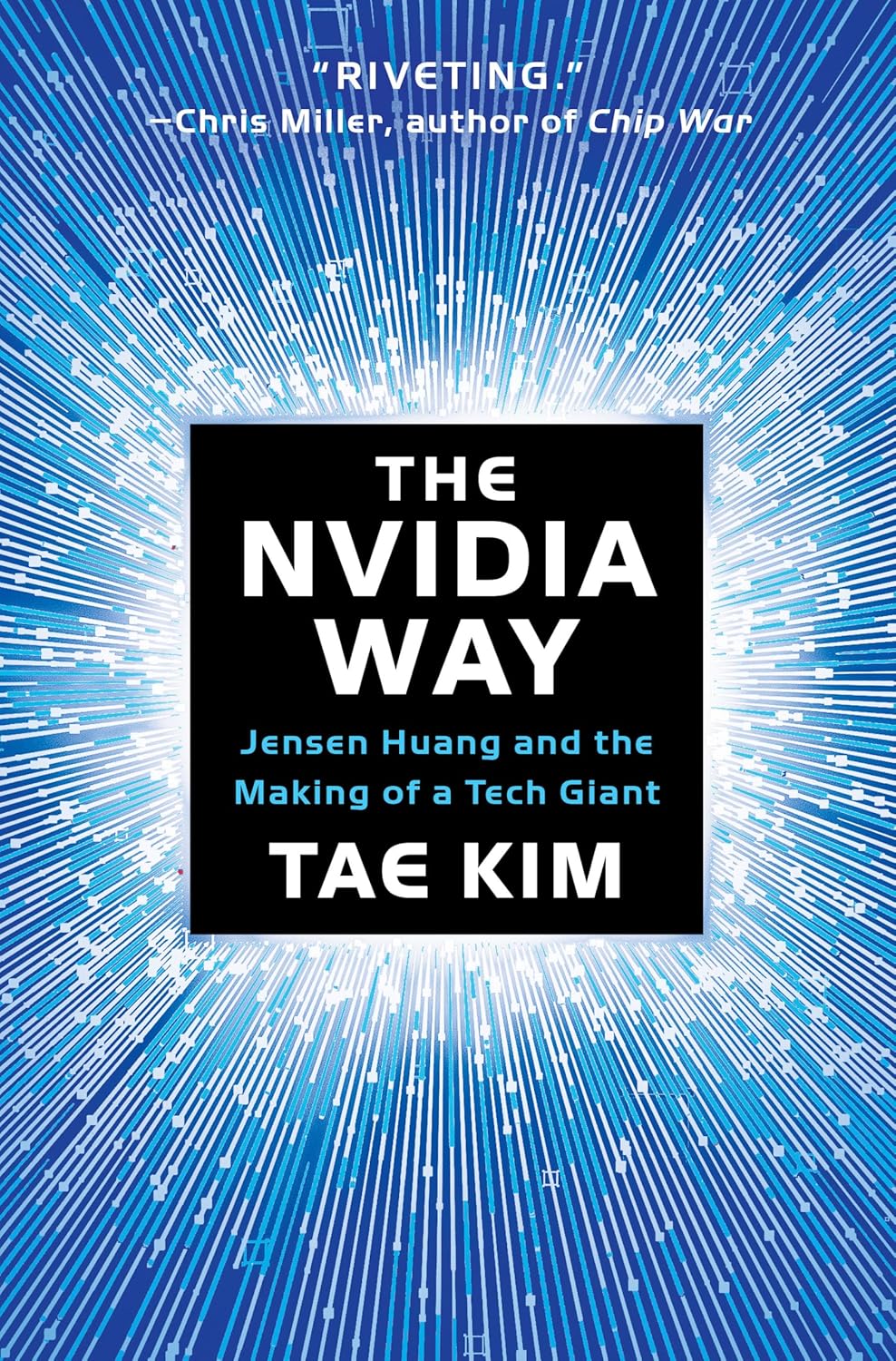
The Nvidia Way: Jensen Huang and the Making of a Tech Giant by Tae Kim

The Nvidia Way: Jensen Huang and the Making of a Tech Giant

Tae Kim

Format: Print/Audio Personal Score: 9.2 / 10

What if the only limit on your pace were the laws of physics.

Essence (why this landed for me)

A story of sheer, sustained hard work that compounds over decades. Jensen and Nvidia are inseparable: he is the company and the company is him, the way Jobs was Apple. Reading this sharpened something I already believed but needed to see proven again: clarity of goals, relentless discipline, and an unwillingness to coast are what separate the top from the rest. It made me want to tighten my own focus and stop underestimating what consistent effort can build.

Insights (mapped to mental models)

Takeaways grouped by mental models, with a short action you can use now.

Operate as if bankruptcy is 30 days away

ACTION Name what could kill my project.
HOW IT SHOWS UP IN THE BOOK Huang repeated the phrase 'our company is 30 days from going out of business' for over three decades, keeping urgency alive long after Nvidia was worth trillions.
MENTAL MODELS Paranoia as Strategy, Margin of Safety
MODEL CLUSTER Systems & Adaptation

Flat structure surfaces truth faster than hierarchy

ACTION Ask the newest person in the room.
HOW IT SHOWS UP IN THE BOOK Nvidia's org is unusually flat. Even junior engineers can raise issues directly to Jensen, eliminating layers that slow signal.
MENTAL MODELS Information Asymmetry, Feedback Loops
MODEL CLUSTER Systems & Adaptation

Only build what others cannot

ACTION Write why this is hard to copy.
HOW IT SHOWS UP IN THE BOOK Huang's golden rule guides every product decision: if a competitor can build it, Nvidia should not bother.
MENTAL MODELS Moats, Comparative Advantage
MODEL CLUSTER Growth & Focus

Speed of light means physics is the only excuse

ACTION Remove one artificial bottleneck.
HOW IT SHOWS UP IN THE BOOK Huang asks teams to work at the speed of light, meaning the only acceptable constraint on execution is the laws of physics, not process, not politics.
MENTAL MODELS First Principles, Constraints -> Creativity
MODEL CLUSTER Logic & Reasoning

Intellectual honesty beats comfort every time

ACTION Say what I actually think.
HOW IT SHOWS UP IN THE BOOK Huang's blunt, sometimes profane feedback is described as profanity in service of intellectual honesty. Pretending to know something you do not is the real offense.
MENTAL MODELS Radical Candor, Map ≠ Territory
MODEL CLUSTER Human Judgment & Bias

Greatness comes from character, not intelligence

ACTION Do the hard thing first today.
HOW IT SHOWS UP IN THE BOOK Huang tells graduates that greatness is not intelligence, it is character, and character forms through pain and suffering.
MENTAL MODELS Antifragility, Deliberate Practice
MODEL CLUSTER Growth & Focus

Pain and suffering are the tuition for achievement

ACTION Name what I am enduring right now.
HOW IT SHOWS UP IN THE BOOK His advice to students is consistently the same: I wish upon you ample doses of pain and suffering. He means it as a gift, not a threat.
MENTAL MODELS Antifragility, Skin in the Game
MODEL CLUSTER Growth & Focus

Six-month cycles outrun the competition's roadmap

ACTION Shorten my release cadence.
HOW IT SHOWS UP IN THE BOOK Nvidia shipped new GPU designs every six months while competitors took years, compounding their lead with each cycle.
MENTAL MODELS Compounding, Tempo
MODEL CLUSTER Systems & Adaptation

Top five priorities keep the entire company aligned

ACTION Write my T5T this week.
HOW IT SHOWS UP IN THE BOOK Huang uses T5T emails, top five things, as a lightweight alignment tool. Every leader sends their five priorities, creating transparency across the org.
MENTAL MODELS Leverage, Leading Indicators
MODEL CLUSTER Growth & Focus

Bet on the platform before the application arrives

ACTION Invest in what is not yet obvious.
HOW IT SHOWS UP IN THE BOOK Nvidia built CUDA years before AI needed it. The bet looked irrational until deep learning exploded and every researcher needed GPU compute.
MENTAL MODELS Optionality, Inflection Points
MODEL CLUSTER Systems & Adaptation

Survive first, then the long game becomes possible

ACTION Protect the runway.
HOW IT SHOWS UP IN THE BOOK The NV1 chip nearly killed Nvidia. Huang flew to Japan to cancel a Sega deal, admitted the product was flawed, and asked for the final payment to survive.
MENTAL MODELS Margin of Safety, Sunk Cost Fallacy
MODEL CLUSTER Logic & Reasoning

Mission is the boss, not the org chart

ACTION Check if I serve the mission or the structure.
HOW IT SHOWS UP IN THE BOOK Huang designates a Pilot in Command for each mission. That person reports directly to him, bypassing normal hierarchy.
MENTAL MODELS Principal-Agent Problem, Ownership
MODEL CLUSTER Systems & Adaptation

Obsession is not a flaw, it is a requirement

ACTION Protect my focus time.
HOW IT SHOWS UP IN THE BOOK Huang works seven days a week, every waking moment, including holidays. He frames obsession as the price of doing anything that matters.
MENTAL MODELS Deliberate Practice, Intrinsic Motivation
MODEL CLUSTER Growth & Focus

Solve the innovator's dilemma by cannibalizing yourself

ACTION Ask what I would build to replace my own product.
HOW IT SHOWS UP IN THE BOOK Huang studied Christensen's work and deliberately disrupted Nvidia's own product lines before competitors could, treating self-cannibalization as strategy.
MENTAL MODELS Innovator's Dilemma, Second-Order Thinking
MODEL CLUSTER Systems & Adaptation

Do not give up on people, raise the bar instead

ACTION Coach before I cut.
HOW IT SHOWS UP IN THE BOOK Huang says he would rather torture people into greatness than give up on them, treating high expectations as a form of respect.
MENTAL MODELS Talent Density, High Expectations
MODEL CLUSTER Human Judgment & Bias

Fear is fuel when you channel it into preparation

ACTION Turn one anxiety into a checklist.
HOW IT SHOWS UP IN THE BOOK Near-bankruptcy in the mid-1990s instilled permanent fear in Huang. He converted that fear into relentless preparation and a culture that never coasts.
MENTAL MODELS Paranoia as Strategy, Antifragility
MODEL CLUSTER Human Judgment & Bias

Absorption Notes (short essay)

The practice I want is Jensen's rhythm when things get hard. He hit walls constantly, near-bankruptcy, failed chips, markets that did not exist yet, and every time he followed the same pattern: name the problem clearly, find whoever can help solve it, set a date, and work backward. When stuck, shrink the problem, not the vision. When the days are bad, remember his line: suffering builds character, and character is what separates greatness from talent. On the difficult days, do not drift. Return to the thing that is hardest right now. On the good days, push further than feels necessary. Lock a ship date and let it create urgency. When a bottleneck appears, treat it as the job, not as a detour. That is what Jensen does: the wall is the work. He did not wait for clarity. He worked until the clarity came. Simple moves, steady rhythm.

Reflection Prompts (product x design x engineering)

Questions to apply the ideas across projects. Pick one or two and use them today.

The wall

What is the hardest problem blocking progress right now and am I treating it as the job or as a detour

First Principles

Name it clearly.

Vision check

What part of the vision is non-negotiable and what have I been confusing for non-negotiable that actually is not

Constraints -> Creativity

Separate the two.

Who knows this

Who has already solved the piece I am stuck on and how do I reach them

Leverage

Ask for help.

Ship date

Have I locked a date and am I working backward from it or am I drifting forward

Commitment Devices

Write the date.

Bad day protocol

Am I drifting to something new because today is hard or because the direction is actually wrong

Sunk Cost Fallacy

Return to the thing.

Honesty audit

Where am I pretending to know something I do not and what would change if I admitted it

Map ≠ Territory

Admit one gap.

Moat check

What about this work is genuinely hard to copy and is that the part I am investing my time in

Comparative Advantage

Protect the edge.

Shrink the problem

What is the smallest version of this bottleneck I can solve today without lowering the standard

Feedback Loops

One piece.

Character test

What hard thing am I avoiding that would build the character I need

Antifragility

Do it first.

Earning it

Am I putting in the work Jensen would respect or am I waiting for the answer to appear

Deliberate Practice

Work until clarity comes.

Quotes (anchors; verbatim)